A new product starts with no links pointing at it, and the first offers to fix that arrive within a week: fifty guest posts, a hundred directory submissions, "high DA" links for the price of lunch. Every one of them sells the same thing, a followed link someone was paid to place.
This guide is about the other way. It covers where the first links for a small software product actually come from, which shortcuts Google names as spam, and what we did for this site. We run website.show, a directory of indie software, so we sit on both sides: we give links and we needed our own.
What counts as buying a link?
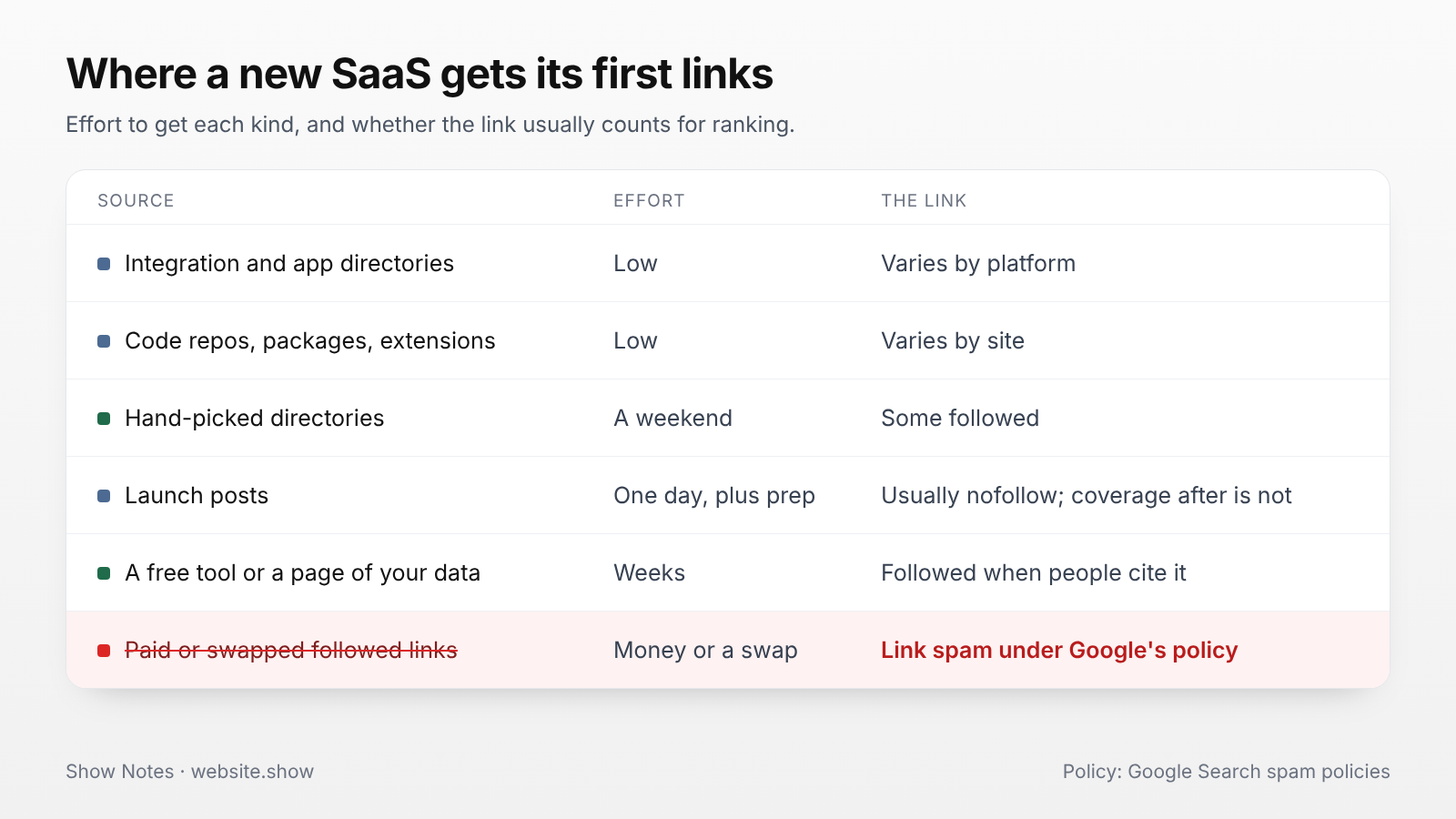
Paying for a followed link, or trading one, is what Google's spam policies list as link spam. The policies name buying or selling links for ranking purposes, excessive link exchanges, links from low-quality directories, and requiring a link in terms of service without letting the site owner qualify it (Google Search spam policies).
A paid link is fine once it carries rel="sponsored" or rel="nofollow". Then it can bring visitors without claiming to be a vote. Our guide to dofollow, nofollow and sponsored covers what each value tells Google and how to check the link you got.
So the test for any offer is short. If money or a swap is the reason the link exists, and the link is followed, it is the kind of link the policy describes. That holds whoever sells it and however it is packaged.
Which links is a new product already owed?
More than most makers claim, because a product that exists in other places can be linked from those places. None of these takes more than an afternoon, and none of them involves asking a stranger for a favor.
- Integration and app directories: if your product connects to a platform, that platform's app directory usually has a page for each integration, with a link back. Check every tool you integrate with.
- Your code: a public repository, a package on a registry or a browser extension listing all carry a homepage field. Fill it in.
- The tools you build with: frameworks, hosting companies and UI kits often run showcases of sites made with them. A showcase page is written to be browsed, which means real visitors.
- Your own profiles: social and community profiles mostly link with
nofollow, so treat them as places people find you, not as ranking signals.
Are directories still worth a weekend?
Yes, as a weekend and not as a plan. Directory links are one link among many on a page about other products too, so each one counts for little. The good ones still bring a first trickle of visitors and help search engines find a site nobody links to yet.
The trick is in choosing which ones. We filtered the 929 directories on our directories page by price, link type, sign-up and real submissions, and 32 passed all four. The write-up of that filter lists the steps, so you can rebuild the short list yourself and finish it in two days.
Submit by hand, one at a time. Services that promise a few hundred directory submissions are the "low-quality directories" pattern from the spam policy, sold in bulk. They also put your product on pages nobody reads. Two weeks after you submit, open each listing and check that it went live and that the link is the kind the directory promised.
What about launch platforms?
A launch is the one moment when people actively look at new products, so it brings visitors first and links second. Show HN, Product Hunt and the smaller launch sites each have their own rules about what you can post and how. Our Show HN guide covers the Hacker News rules, and our comparison of launch platforms covers free plans, prices and the link each one gives.
The link from a launch page itself is often nofollow. The links that matter come afterwards. Someone writes about a product they found on launch day, adds it to a roundup or mentions it in a newsletter. Those are written by people who chose to link, which is exactly the kind of link the policy has no problem with.
How do you make something people want to link to?
Build one thing that is useful without your product. People link to answers, tools and numbers. They rarely link to a homepage that sells something.
Two kinds work for small teams:
- A free tool that does one job in the browser. We built five for website.show, including a site check and an llms.txt generator. Each one solves a problem a maker has before they need a directory, and each page can be linked on its own. They are a few weeks old, so we can't tell you yet how many links they earned. We built them because a tool page can be cited, and a product page rarely is.
- A page of your own data. Our directory filter is an example: 929 rows of public lists turned into one number someone can quote, "32 were left". Any product that sees data others don't can do the same. Count something real, show how you counted, and date it.
Then tell the people who write about your category. Authors of "best tools for X" articles update them, and a short note with one accurate fact about your product helps them more than a request for a link. Newsletters and podcasts in your niche look for the same thing: a story or a number, not a pitch.
Where is the line with badges and link swaps?
Badges sit close to the line, so it is worth being precise. A badge on your site that links to a directory, in exchange for a followed link from that directory, is a link exchange. Google's policy names excessive link exchanges as link spam. One or two are a different thing from a site whose links mostly come from swaps.
We use a badge ourselves, so here is how we keep it on the right side. A listing on website.show never requires a badge or a payment, and the free listing links with nofollow. The badge only adds a followed link to a listing that already exists, and our badge rules say so in public.
For website.show's own links we were on the other side. We listed it on a handful of launch directories, and most of them keep a free listing only while their badge is on the homepage. Their six badges sit on our homepage only, not in a footer on every page, because links repeated across a whole site are one of the patterns the policy describes.
How do you know it is working?
Search Console's Links report lists the sites that link to you, as Google sees them. It is free and comes straight from Google, which makes it the most reliable count you can get. Check it monthly, not daily: links show up there with a delay, and a new site's list is short for a while.
Visitors tell you more than counts do at the start. Tag the links you control with UTM parameters and see which ones send people who sign up. A link that sends ten real users is worth more than fifty that send nobody, whatever they do for ranking.
FAQ
How many backlinks does a new SaaS need?
There is no number, and nobody outside Google can give you one honestly. A few relevant links from pages people actually read beat a long list from pages nobody visits. Aim for links you would be glad to have even if they did nothing for ranking.
Is it safe to pay for a directory listing?
Paying for a listing is fine, but paying for a followed link is what the policy is about. A directory that sells listings should mark paid links sponsored or nofollow, or say clearly what the money buys. Read its terms, and value the listing by the visitors it can send.
Do nofollow links help a new site at all?
They bring visitors, and visitors are what a new product needs most. They also help people find you through pages that are already read. As a rule they don't pass ranking value, so count them as traffic, not as votes.
Should I use a link-building agency?
Ask one question before anything else: does the agency place links it pays for? If the answer is yes, or vague, you are buying the risk along with the links. Agencies that do outreach for real coverage exist, but they cost more than a new product usually has.