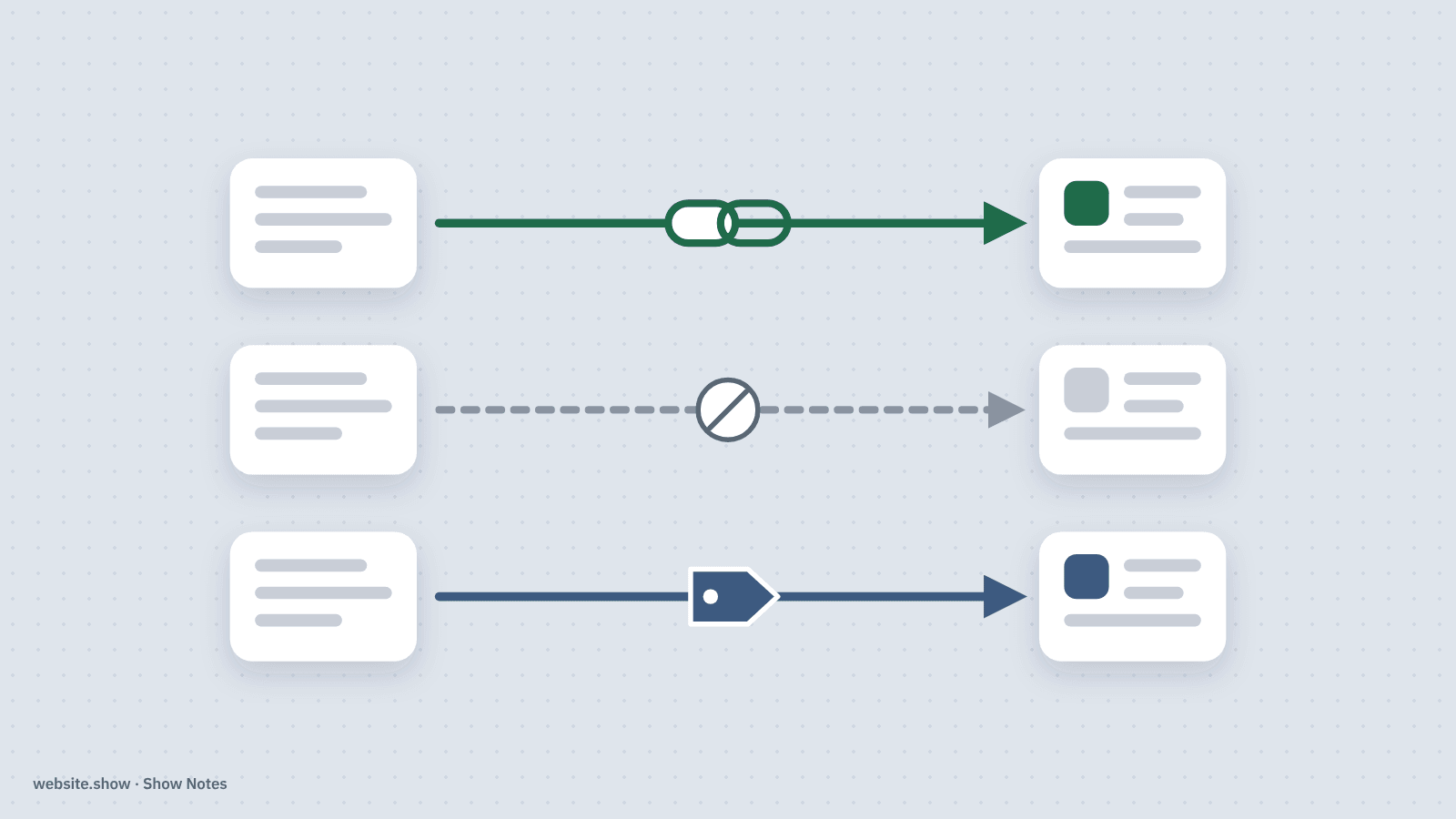
Directory pricing pages sell the word dofollow as if it were a feature you can switch on. It is not a feature, and it is not even an attribute. It is the name people give to an ordinary link that carries none of the three values that ask search engines to hold back.
This guide covers what those values mean, what Google says it does with them, how to see which kind of link a directory actually gave you, and what a listing is worth either way. We run a directory ourselves, website.show, so the last part says how we handle the links we give.
What do nofollow, sponsored and ugc tell Google?
They are values of the rel attribute on a link, and each one describes the link rather than the page it points to.
The HTML standard defines only one of them. It says nofollow means the author or publisher of the page does not endorse the page it links to (HTML Living Standard, link types). The other two come from Google, which added them in September 2019:
rel="sponsored"marks ads and paid placements. Google calls it the preferred value for paid links, whilenofollowis still accepted.rel="ugc"marks links in content users wrote, such as comments and forum posts.rel="nofollow"is for any other link you don't want to vouch for.
A link can carry more than one, written as rel="ugc nofollow". Values are separate words and case does not matter, so NOFOLLOW means the same as nofollow.
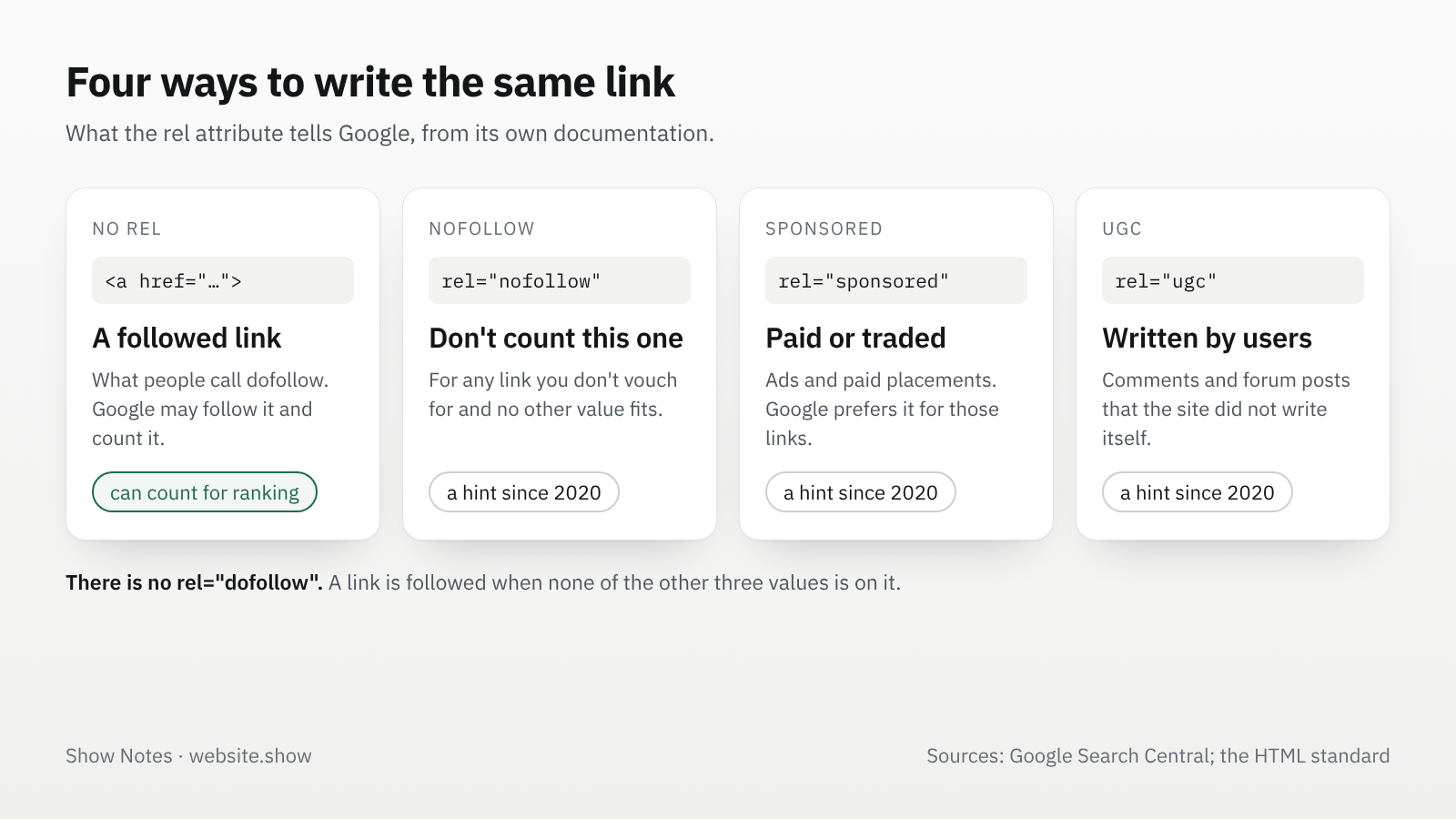
There is no rel="dofollow" in the standard or in Google's documentation. A browser ignores it, and a link that carries it is simply a link. When a directory says your listing is dofollow, it means the link has no nofollow, sponsored or ugc. You can check that yourself in a minute, and the section on checking shows how.
Does Google ignore every nofollow link?
Not entirely: since March 1, 2020, Google treats all three values as hints about which links to count, rather than as commands it always obeys (Google Search Central Blog, 2019).
Its current documentation puts it more plainly: links marked this way will generally not be followed. It also warns that the page at the other end may still be crawled if Google finds it another way, through a sitemap or a link from another site (Qualify your outbound links).
In practice, read a nofollow link as one that does not pass ranking value. Google keeps the right to make an exception, and it does not say when it does. Nobody outside Google can tell you which nofollow links counted, so be wary of any directory or SEO seller that claims to know.
When does a link have to be marked sponsored?
Whenever it was paid for or traded, since Google's spam policies list buying or selling links for ranking purposes as link spam, and say such links are fine once they carry nofollow or sponsored (Google Search spam policies).
The same list names a few other patterns that matter to anyone listing a product:
- excessive link exchanges, the "link to me and I'll link to you" kind;
- links from low-quality directories and bookmark sites;
- requiring a link as part of terms of service or a contract without letting the site owner qualify it;
- links spread across the footers or templates of many sites.
For a maker, the practical reading is simple. A followed link you pay for is exactly the kind of link the policy is about, whoever sells it. A site whose links come mostly from bought or traded placements fits the pattern the list describes. Keep directory listings a small part of how people find you, and put most of the effort into pages that answer what your users search for. Our comparison of launch directories makes the same point: a directory link is a bonus on top of a launch, not the plan.
How do you check what kind of link you got?
Open your listing page, find the link to your site and look at its rel attribute. It takes about a minute in any desktop browser:
- Right-click the link to your site and choose Inspect.
- The developer tools open with the
<a>element selected. - Read the
relattribute on it, if there is one.
What you see will look like one of these:
<!-- Followed: no nofollow, sponsored or ugc -->
<a href="https://yourproduct.com" rel="noopener">yourproduct.com</a>

<!-- Not followed -->
<a href="https://yourproduct.com" rel="nofollow noopener">yourproduct.com</a>
<a href="https://yourproduct.com" rel="sponsored">yourproduct.com</a>
Values like noopener and noreferrer are about browser security and privacy. They have nothing to do with search, so a link with only those is still followed.
Check again a few weeks after you list. Some directories change a link after launch day, and badge-based ones turn it back to nofollow when the badge disappears. A page can also be built by JavaScript after it loads. If view-source shows something different from Inspect, trust Inspect, since it shows the page as the browser built it.
What is a directory listing worth with a nofollow link?
Often more than the link, because a listing can bring you three separate things, and only one of them depends on the link being followed.
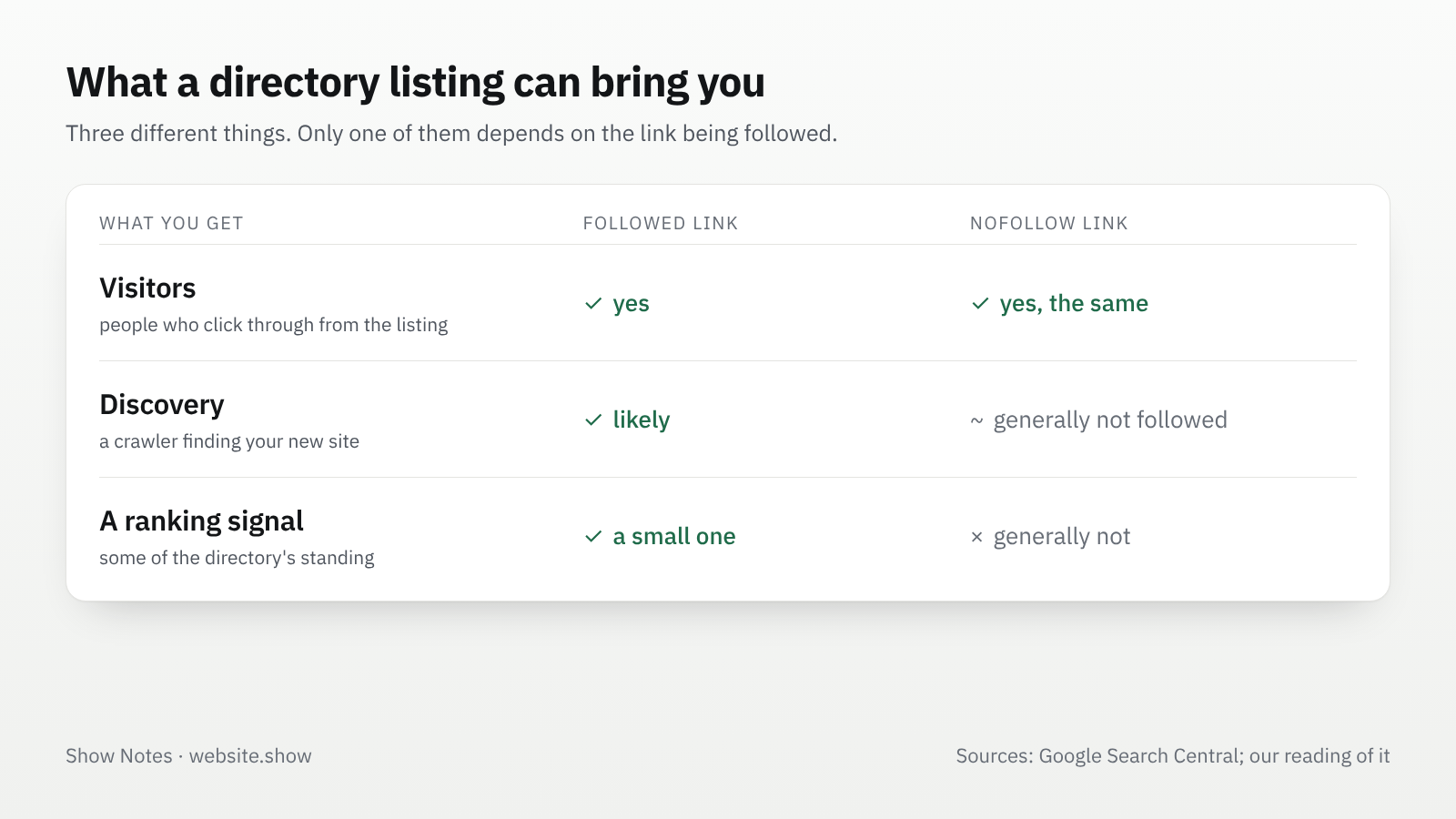
The first is visitors. People who click through from a listing reach your site whatever the rel says. For a product in its first months, a handful of the right visitors is worth more than any link, because one of them may become a user who tells you what to build next.
The second is discovery. A brand new site with no links pointing to it can take a while for search engines to find. A followed link from a page that is already crawled helps. You can also submit your sitemap in Search Console, which works whatever kind of links you have.
The third is ranking. A followed link from a relevant page passes a little of that page's standing to yours. From a directory, that little is usually small. It is one link among many on a page about other products too.
So judge a listing in that order. Ask whether the directory has readers who could want your product, whether the page about you is good enough to send someone to, and only then what the link is.
How does website.show handle the links it gives?
A listing here never depends on a link back or a payment. You can list your product for free and get a page and visitors, with nothing to add to your site. That free listing links to you with nofollow. We keep it because Google's policy treats a link required as a condition of service, with no choice to qualify it, as link spam.
A person reviews every product before it goes live. Each week we also check that every site we link to still answers, is not parked, does not redirect somewhere else and is not flagged as unsafe. A site that fails loses its followed link and goes back to nofollow. Erring toward nofollow costs us little; vouching for a domain that changed hands would cost more.
When a listing's link is followed, our badge rules and Terms say why and on what conditions, and both pages are public. You can submit a product on the free listing and decide about anything else later from its manage page.
FAQ
Is a nofollow link worthless?
It brings visitors the same way a followed link does, and visitors are what a new product needs most. It also gives people a page about your product to find and share. It just doesn't pass ranking value, as a rule.
Can I add rel="dofollow" to make a link count?
It won't, because the value does not exist in the HTML standard or in Google's documentation, so it changes nothing. A link counts as followed when it has no nofollow, sponsored or ugc. Adding a made-up value is harmless, but it is not a setting.
Does rel="noopener" make a link nofollow?
It doesn't: noopener stops the opened page from reaching back into the page that opened it, which is a security measure. noreferrer also hides where the visitor came from. Neither one tells search engines anything about the link.
Should my own badge links to directories be nofollow?
That is your choice, and Google's policy says you should be free to make it. On website.show a nofollow badge simply means your listing stays on the free nofollow option. Other directories set their own rules for their badges, so read them before you add one.
Sources
- Qualify your outbound links to Google, Google Search Central
- Evolving "nofollow": new ways to identify the nature of links, Google Search Central Blog, September 2019
- Spam policies for Google web search: link spam
- HTML Living Standard: link types, WHATWG
- website.show badge rules
We read each Google page above on October 7, 2026. Google updates its documentation without notice, so check the page itself before you rely on a detail.