A directory page is a list of names and one-line taglines, and people scan it. Nielsen Norman Group found back in 1997 that 79% of its test users scanned any new web page and only 16% read word by word. Nothing about a list of thirty products has made people read more carefully since.
So your tagline gets a glance, and the glance decides whether anyone sees the rest. This guide covers how to write the tagline, the description and the questions under a listing, with made-up before and after examples and the rules we apply to every listing on website.show.
What makes a SaaS tagline work?
It says what the product does, for whom, in words the buyer already uses. A reader should be able to repeat it to a colleague without having seen the site.
Most weak taglines fail the same way: they describe a feeling instead of a function. "The future of work" and "Supercharge your workflow" fit ten thousand products, so they tell a scanning reader nothing and give a search engine no words to match.
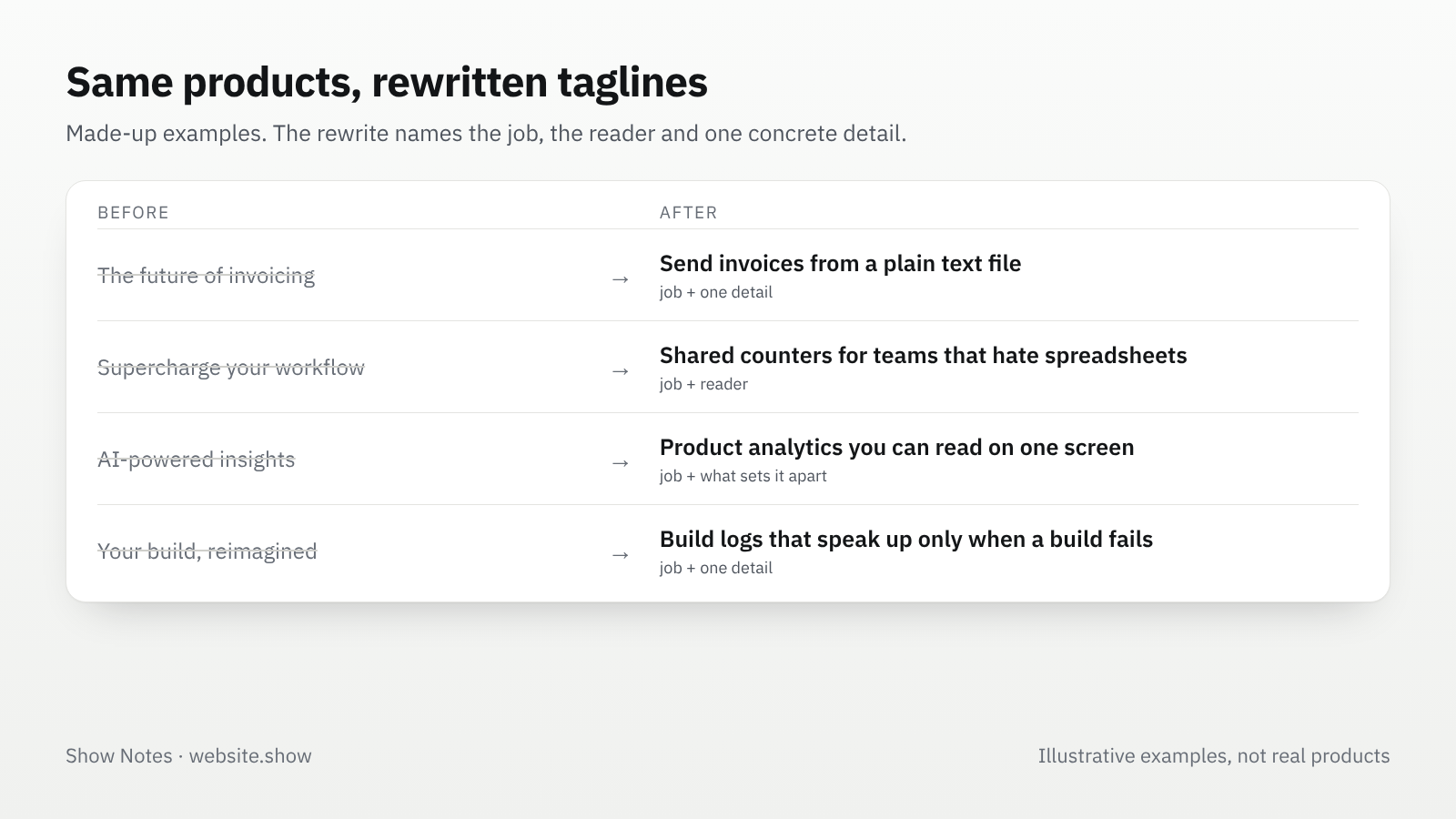
A tagline that works usually has three parts, though not always in this order:
- The job: a verb and an object, like "turns screenshots into posters" or "sends invoices from a text file".
- The person: who it is for, when that narrows it, as in "for small teams" or "for Shopify stores".
- One detail that sets it apart: a limit, a method or a result, such as "without a server" or "in under a minute".
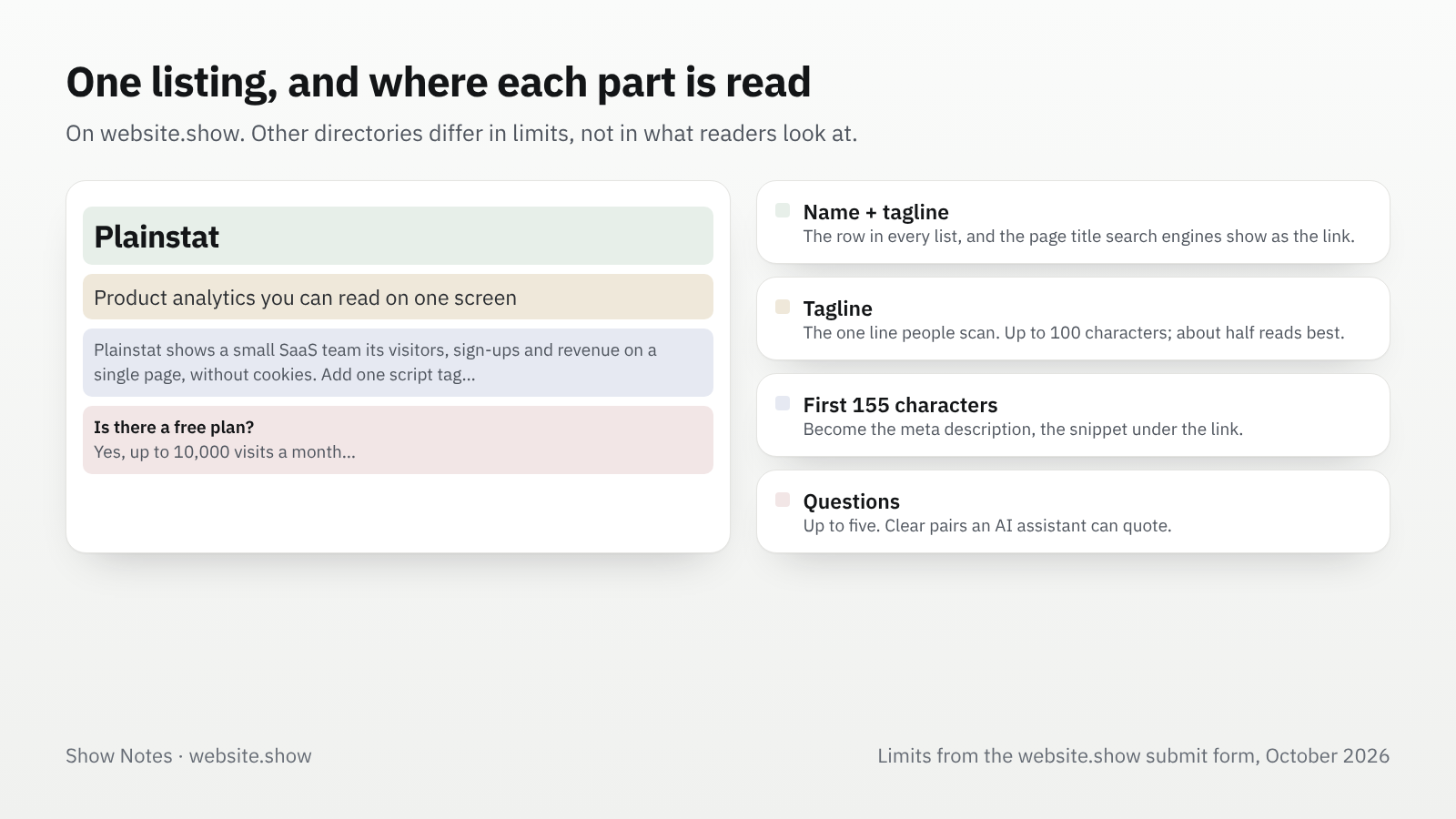
Short wins in a list: our own form allows up to 100 characters, and the taglines that read best on the shelf tend to use about half of that.
Where does your tagline show up?
In more places than the directory list. On website.show the title of a listing's page is the product name followed by the tagline, so the tagline is also what Google shows as the blue link when your listing page appears in search. Product Hunt shows its tagline under the name on every launch row and on the product page.
That gives you one more test. Would someone searching for a tool like yours type any of the words in your tagline? "Product analytics on one screen" contains a phrase people search for. "Clarity for founders" does not.
How do you write the description?
Lead with the most useful sentence, because on our listing pages the first 155 characters of the description become the meta description, the grey text that search engines may show under the link. Product Hunt caps its short description at 260 characters. Either way, the opening is what most readers see.
A description that does its job answers these, in this order:
- What the product does, in one plain sentence.
- Who it is for, and what they do today instead.
- How it works, in two or three concrete steps.
- What it costs, or where to see the price.
- What it does not do, if that saves the wrong people a click.
Write in paragraphs of one idea each. Keep it in your own words: the same text pasted into every directory reads as copied to a reviewer, and search engines see one more copy of a page they already have.
On website.show the description must be at least 80 characters, and a listing page is open to search indexing once the description and the questions under it reach 300 characters together, and the description says more than the tagline. Below that, the page exists for visitors but asks search engines not to index it, because a page with two lines on it is thin.
What questions should a product listing answer?
The ones a buyer asks before they click through. Three cover most products:
- What does it cost, and is there a free plan or a trial?
- Does it work with what I already use?
- What happens to my data?
Our form lets you add up to five questions with answers under a listing. They help people decide, and they give AI assistants clear question and answer pairs they can quote. Our guide to blocking or allowing AI crawlers covers whether those assistants can read your own site too.
What gets a listing turned down?
On website.show, an automatic check and a person review every listing against the same short list of rules, published on the submit page. The two that catch honest makers are the ones about the text:
- A listing that does not match the site: if the tagline promises a feature the homepage never mentions, or a tag the site clearly contradicts, the listing is refused until the two agree. Write the listing from the site, and change the site first if it is out of date.
- A listing not written in English: the site is English, so the listing has to be. A product whose own site is in another language can still be listed, with the listing itself in English.
The other rules cover sites that do not load and content we do not list at all, such as spam or gambling. A description is shown as text, with no links or HTML, so a listing cannot carry extra links to other sites.
How do you test a tagline before you launch?
Read it to someone who has never seen the product, then ask what it does. If they cannot say it back in their own words, rewrite it.
Two quicker checks need nobody else. First, cover your logo and ask whether the tagline could belong to a competitor; if it could, it needs a detail only you have. Then search for its key phrase and see who ranks: if the results are about something else, buyers do not use your words for this.
When the tagline is ready, use the same one everywhere, from your homepage to every directory. A buyer who sees the same short description in three places remembers it, and so do the systems that summarize the web. Our comparison of launch directories covers where those places are.
FAQ
How long should a product tagline be?
Short enough to read at a glance in a list, which in practice means under ten words or about 60 characters. Directories set their own limits; ours is 100 characters, and the ones that read best use far less.
Should a tagline include keywords?
It should include the words your buyer uses for the job, which are usually the keywords anyway. Do not stuff in more than one or two. A tagline that reads like a list of search terms loses the human reader it was written for.
Can I use the same description on every directory?
You can use the same tagline everywhere, and you should. Write the longer description fresh for each place where it matters, or at least rework it, so each page offers something of its own.
Sources
- How users read on the web, Nielsen Norman Group, 1997
- How to post a product, Product Hunt Help Center
- website.show listing rules
The limits we quote for website.show are the ones in our submit form on October 8, 2026. Product Hunt's limits are from its help article as published on that date.