
Most of the work of listing a startup in directories is not choosing where to go. It is typing the same name, tagline and description into form after form, each with its own length limit, its own sign-up and its own idea of a category.
Done carelessly, that work produces a pile of near-identical pages on sites nobody visits, which is what Google's spam policy has in mind when it names low-quality directory links as link spam. Done carefully, it puts your product in front of people who browse those lists and gives search engines and AI assistants several independent pages that describe it.
This guide is about the careful version. It covers what to prepare, how to judge a directory before you fill in its form, how to pace the work and how to keep track of it.
Is it still worth submitting a startup to directories?
Yes, if you pick the directories and keep your expectations plain. A directory listing rarely sends a flood of visitors. What it gives you is a page on another site that names your product, says what it does and links to it, sometimes with a followed link.
For a new product with no other mentions on the web, a dozen good pages like that are worth more than a hundred thin ones. They help people who search your product's name find a second opinion, and they give assistants like ChatGPT more than your own homepage to read.
What it is not worth is submitting everywhere. A directory that lists anything for a fee, publishes nothing new or hides every listing behind a badge on your homepage costs you time and gives little back. Our comparison of launch directories covers the bigger names one by one.
Prepare one submission kit before the first form
The single biggest time saver is to stop writing in the form. Write everything once, in a document, in the lengths forms usually ask for, and copy from it.
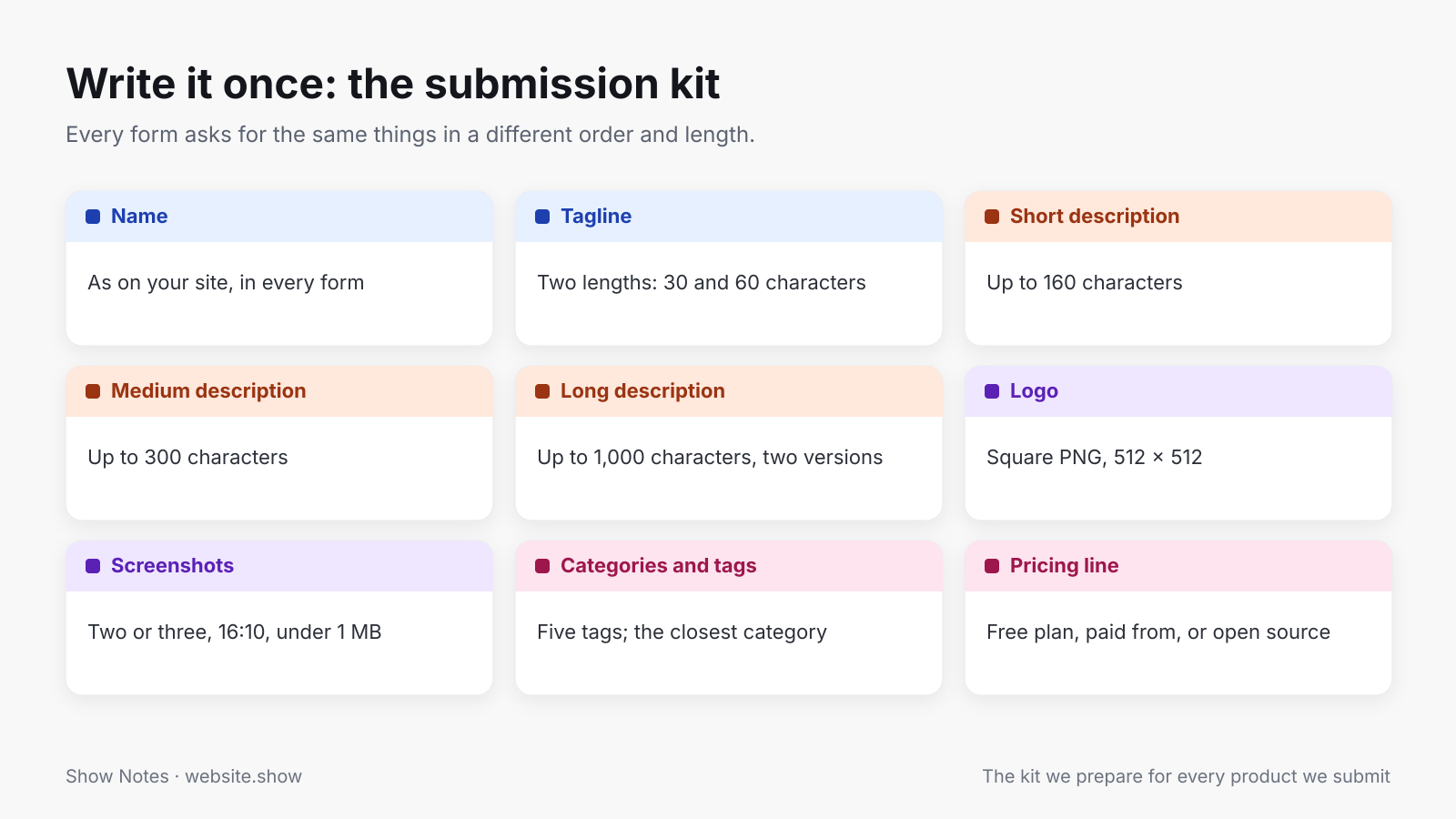
Here is what goes in it:
- Name, exactly as on your site, with one spelling and capitalization you never vary.
- Two taglines, one of about 30 characters and one of about 60, because short fields cut longer ones mid-word.
- Three descriptions of about 160 characters, about 300 and up to 1,000, with the long one in two versions so you do not paste the same long text on every site.
- A square logo, 512 by 512 pixels, as a PNG, which a form can shrink to whatever size it needs.
- Two or three screenshots in a 16:10 shape, each under 1 MB, showing the product rather than a marketing banner.
- Categories and five tags that describe the job your product does, in the words a buyer would search.
- One pricing line: free, free plan with paid tiers from a given price, or open source.
Add the answers forms ask for again and again: the year you started, team size, where you are based, a founder name and a support email. Write them down once, so you do not invent a slightly different answer on every site.
If writing the tagline and descriptions is the part you are stuck on, our guide on how to write a SaaS tagline walks through it with examples.
Check a directory in a minute before you fill in its form
Most wasted submissions could have been skipped from the outside. Before you start a form, open the directory and look for these things:
- Does it list products like yours? Scroll its newest listings. If they are casinos, essay writers and agencies, your SaaS does not belong there.
- Is it still alive? The newest listing should be days or weeks old, not last year.
- What does the free option actually give? Many sites offer a free listing only if you put their badge on your homepage, or put free submissions in a queue that moves for paying customers. Decide before the form whether you can live with that.
- Is the link followed? Open any listing and look at the link to the product. Our explainer on dofollow, nofollow and sponsored links shows how to check it in a browser.
- Are its listings indexed? Search
site:and the directory's domain in Google. A site whose product pages never show up in search will not help yours either.
Our list of startup and SaaS directories shows the price, link type and sign-up method for each site we track, so you can filter before you open a single form. Treat it as a starting point and check the site itself, because directories change their rules without notice.
Pace the submissions over days
Doing all your submissions in one evening feels efficient and rarely is. Many directories send a confirmation email, some only after a delay, and a few ask you to confirm again a day later. Others moderate by hand and answer within a week. If you send everything at once, you spend the next days hunting through your inbox for which email belongs to which form.
A few a day works better. You keep each confirmation next to the form it belongs to, you notice when a site asks for something you did not prepare, and you can improve your kit as you go. It also keeps your submissions looking like what they are, a person listing a product, rather than a burst from one address that some sites treat as spam.
Use one email address for all of it, ideally one made for the purpose, so confirmations and newsletters land in one place and stay out of your personal inbox.
Keep one row per directory, with proof
A submission you cannot prove is one you will end up sending twice. Keep a simple table, one row per directory, from the first form.
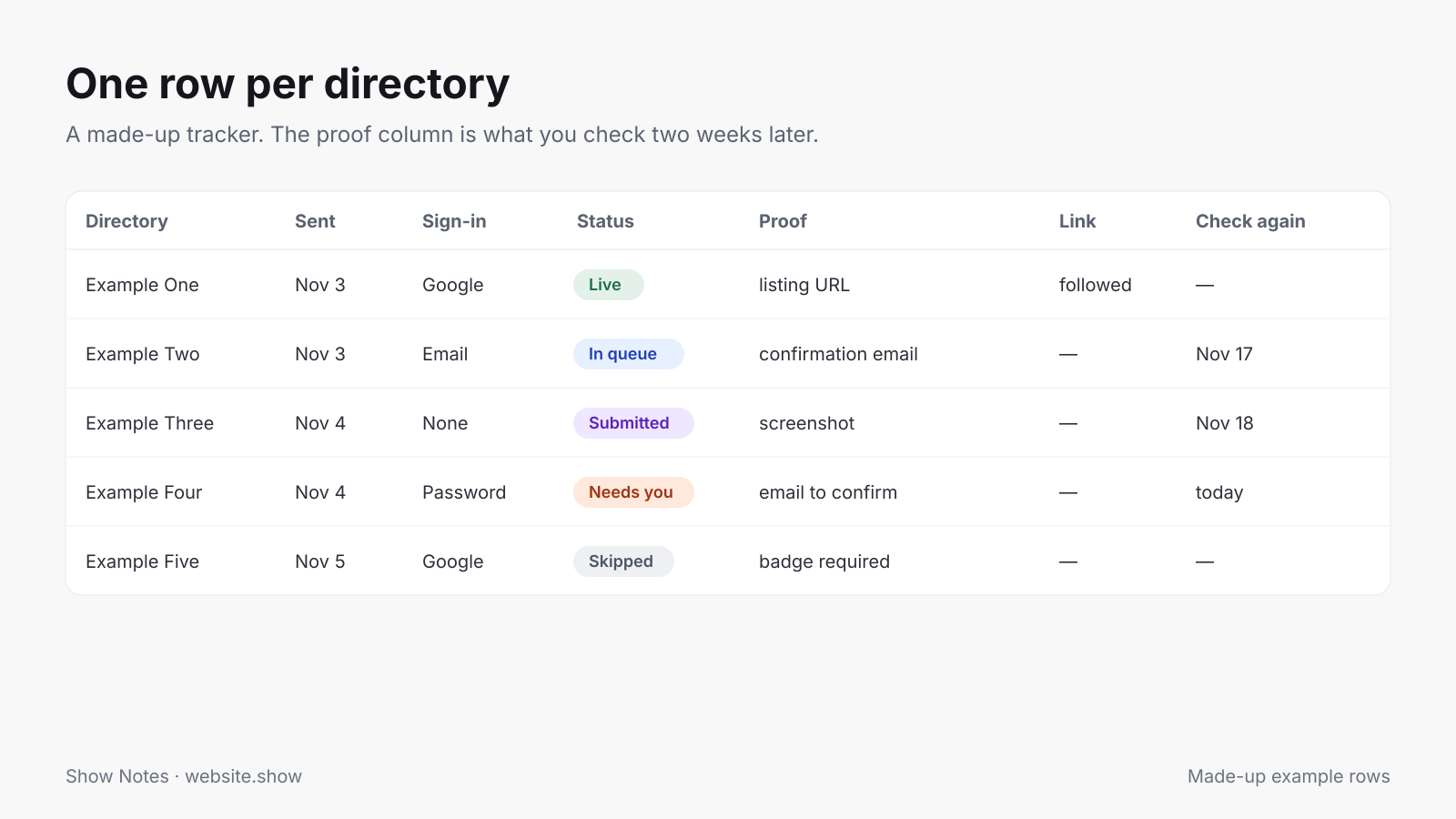
The columns that matter are the date you sent it, how you signed in, what you have as proof, and when to look again. Proof is the listing's address if it went live at once, the confirmation email or a screenshot of the page that thanked you. Note how you signed in, because a year from now you will want to update your listing and will not remember whether it was Google, a password or a magic link.
Avoid the mistakes that waste a submission
A few habits cost more submissions than any directory rule:
- Leaving paid extras ticked: many forms pre-select "feature my listing" or "skip the queue", so untick them unless you decided to pay.
- Keeping the site's own guess: some directories fill the description from your homepage, and your kit's text was written for the purpose.
- Pasting the same long description everywhere instead of alternating the two long versions, or at least reworking the opening lines.
- Picking the first category instead of the closest one from the site's own list, even if finding it takes a minute of scrolling.
- Agreeing to every newsletter when the only box you must tick is the one for the terms.
What to expect after you submit
A submission is not yet a listing: some directories publish at once, some after a human looks at your product, and some put free listings in a queue that can run for months. A few will turn you down without a word.
So check your table two weeks after each batch. Open the listings that went live, confirm they link to the right address, and note which ones are still waiting. To see whether search engines found your new pages, our guide on checking if Google indexed your site applies to directory pages too.
If a week of forms is more than you can spare, that is the work our directory submission service does for you: we pick directories that fit your product, write the texts and send you proof of every submission. You still get the kit, the table and the proof described above, without typing them in yourself.
FAQ
How many directories should a startup submit to?
As many as fit your product and pass the one-minute check, which for most products is dozens rather than hundreds. A smaller set of directories that list products like yours, publish regularly and get indexed is worth more than a long list of sites that do not.
Do directory listings still help SEO?
They can, modestly. A followed link from a site that search engines trust passes some value, and every listing is one more page that describes your product in its own words. Low-quality directories do the opposite, which is why the check before each form matters more than the count.
Should I use a different description on every directory?
Use the same name and tagline everywhere, so people and search engines recognize the product. Vary the longer description, at least between a couple of versions, so the pages do not repeat each other word for word.
Sources
- Spam policies for Google web search: link spam, Google Search Central
- Qualify your outbound links to Google, Google Search Central
- Startup and SaaS directories list, website.show
The field lengths in the submission kit are the ones we prepare for every product we submit, as of November 25, 2026. Directories set their own limits and change them.