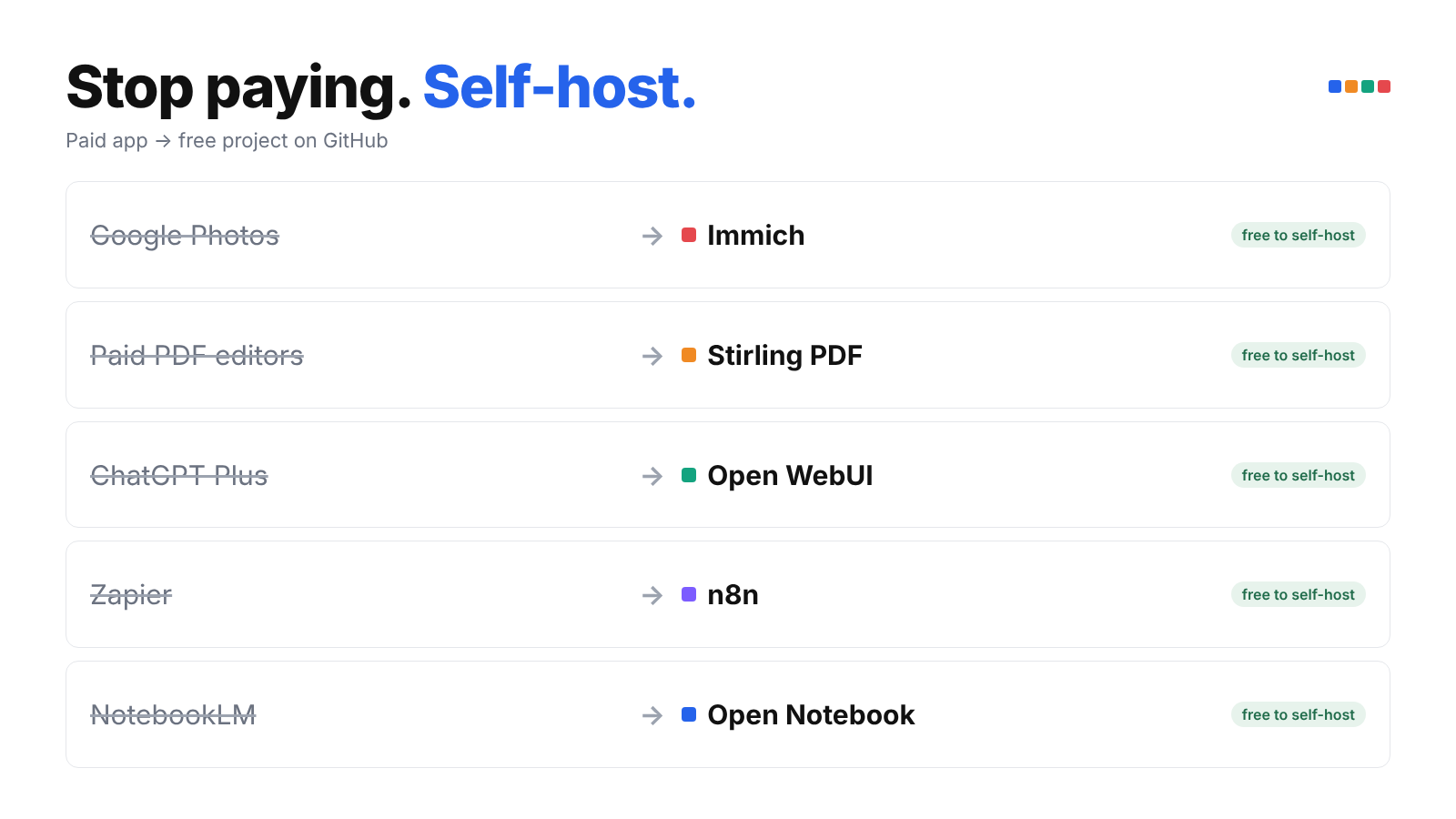
A lot of the monthly subscriptions a small team pays for now have a free, open-source version on GitHub that you can run yourself. "Free" here means no license fee: you still need a computer or server to run it, and you are the one who updates it and keeps backups.
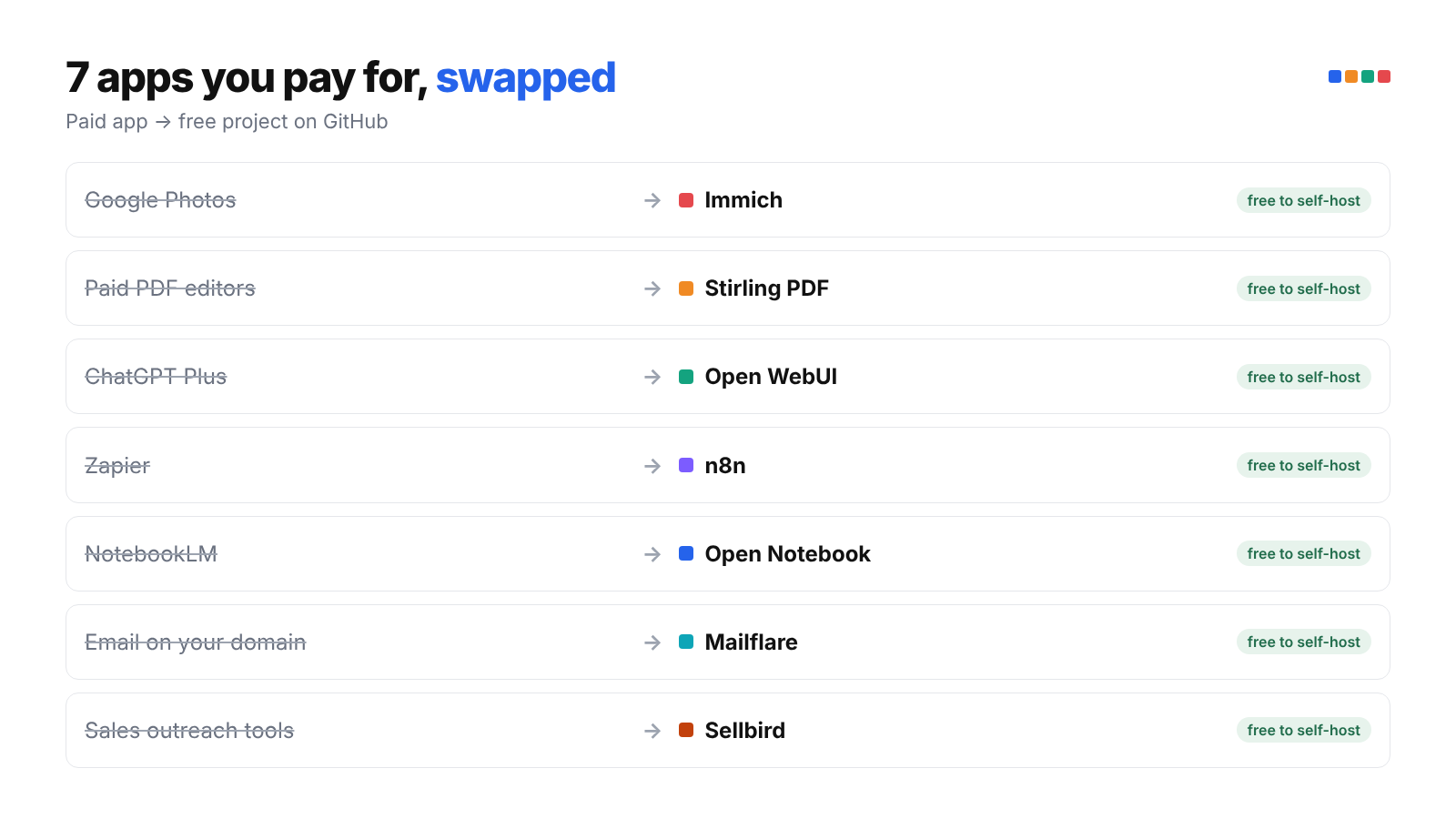
Below are seven of them, each paired with the paid app it stands in for. We read every project's own page between November 14 and November 25, 2026. Prices for the paid apps come from AIVario's reviews, with the date each was checked. Where a project is "source-available" rather than open source, we say so.
What replaces Google Photos?
Immich is a self-hosted photo and video library under the AGPL-3.0 license. Its phone app backs up your camera roll automatically, and the web app has albums, shared albums, a map of where photos were taken, face recognition and search by what is in a picture.
The catch is the one its own README spells out: your photos now live only where you put them, so keep a proper backup. The usual rule is three copies, on two kinds of storage, with one somewhere else.
Is there a free alternative to paid PDF editors?
Stirling PDF is an MIT-licensed PDF toolkit with more than 50 tools: edit, merge, split, sign, redact, convert, OCR and compress. It runs as a desktop app, in the browser or on your own server, and your documents are not sent to an outside service. On a machine with Docker it starts with one command and opens on localhost:8080.
It covers everyday PDF chores well. If your work depends on a specific feature of a paid editor, check that tool is on Stirling's list before you cancel.
Can you run a ChatGPT-style app yourself?
ChatGPT Plus costs $20 a month (AIVario, checked October 2, 2026). Open WebUI is a chat app you host yourself that works fully offline with local models through Ollama, or with any OpenAI-compatible API.
Two things to know. It is released under the Open WebUI License, not an OSI open-source license, so read the terms if you plan to rebrand it for a business. And it is only the app: the answers come from whichever model you connect, so a strong local model needs a strong computer, and a paid API still bills per use.
What is a free alternative to Zapier?
Zapier's Professional plan starts at $19.99 a month billed yearly (AIVario, checked October 1, 2026). n8n is free to self-host, has more than 1,500 integrations and over 9,000 workflow templates, and can call OpenAI, Anthropic, Google or open models inside a workflow.
n8n is "fair-code", not open source: the code is public and free to self-host, but its license limits reselling it as a service.
Is there an open-source NotebookLM?
NotebookLM itself is free, so this swap is about privacy, not price. Open Notebook is an MIT-licensed take on the same idea: add PDFs, videos, audio and web pages, chat with them, search them and turn them into a multi-speaker podcast. It works with more than 20 model providers, including local models through Ollama, so your research does not have to leave your machine.
How do you get email on your own domain for free?
Mailflare is an AGPL-3.0 inbox for your own domain built on Cloudflare. Mail comes in through Cloudflare Email Routing, which is free, and your messages and attachments stay in your own Cloudflare database and storage.
Sending is where the fine print is. Its README suggests Resend's free tier (3,000 emails a month) or Amazon SES; Cloudflare's own sending needs the $5 a month Workers Paid plan. You also need your domain in the same Cloudflare account. If you would rather not use Cloudflare, it can run with Docker on any server.
Is there an open-source AI sales agent?
Sellbird, formerly called Harvey, is an AGPL-3.0 outreach agent. It finds companies and the people who decide, verifies their emails, writes a personal cold email and handles the replies. The AI part runs on a Claude Pro or Max, or ChatGPT, subscription you already pay for, so there are no API keys or per-token bills, and drafts wait for your approval by default. A hosted version was in early access in November 2026. If you are still looking for your first users, start with how to get your first 100 users before you automate outreach.
Cold email has rules of its own: check the anti-spam law where your recipients live, and keep the approval step on.
How do you install these without being a sysadmin?
Most of these projects ship a Docker image, and the fastest route for a non-specialist is to let an AI coding assistant do the typing. Paste the GitHub link into Claude Code and ask it to install the project on your computer or home server; it reads the README and runs the steps, and you approve each command. If you are new to adding tools to Claude, our list of Claude connectors for launching a site covers how approvals work.
Three habits make it safe:
- Read the README's requirements first: memory, disk and whether it needs a domain.
- Keep the assistant's command approval on, so you see what it runs.
- Set up backups on day one, before you move anything important in.
FAQ
Are self-hosted apps really free?
There is no license fee, but you pay in hardware and time. A spare computer or a small server runs most of these, and some need a paid service for one part, like sending email or the AI model behind a chat app.
Is "free to self-host" the same as open source?
Not always. Immich, Stirling PDF, Open Notebook, Mailflare and Sellbird use open-source licenses. n8n is fair-code and Open WebUI has its own license: both are free to run yourself, with limits on reselling them.
Can I list my own open-source project on website.show?
Yes. Listing is free, and a free or open-source tool gets its own page like any other product. See where to launch your product for the other places worth posting it.
Sources
- Each project's GitHub page and README, read November 14 to 25, 2026: Immich, Stirling PDF, Open WebUI, n8n, Open Notebook and Mailflare.
- Sellbird: its listing and AlphaSignal's November 2026 write-up; we could not open its GitHub page on the day we checked.
- ChatGPT Plus and Zapier prices: AIVario reviews, checked October 2 and October 1, 2026.