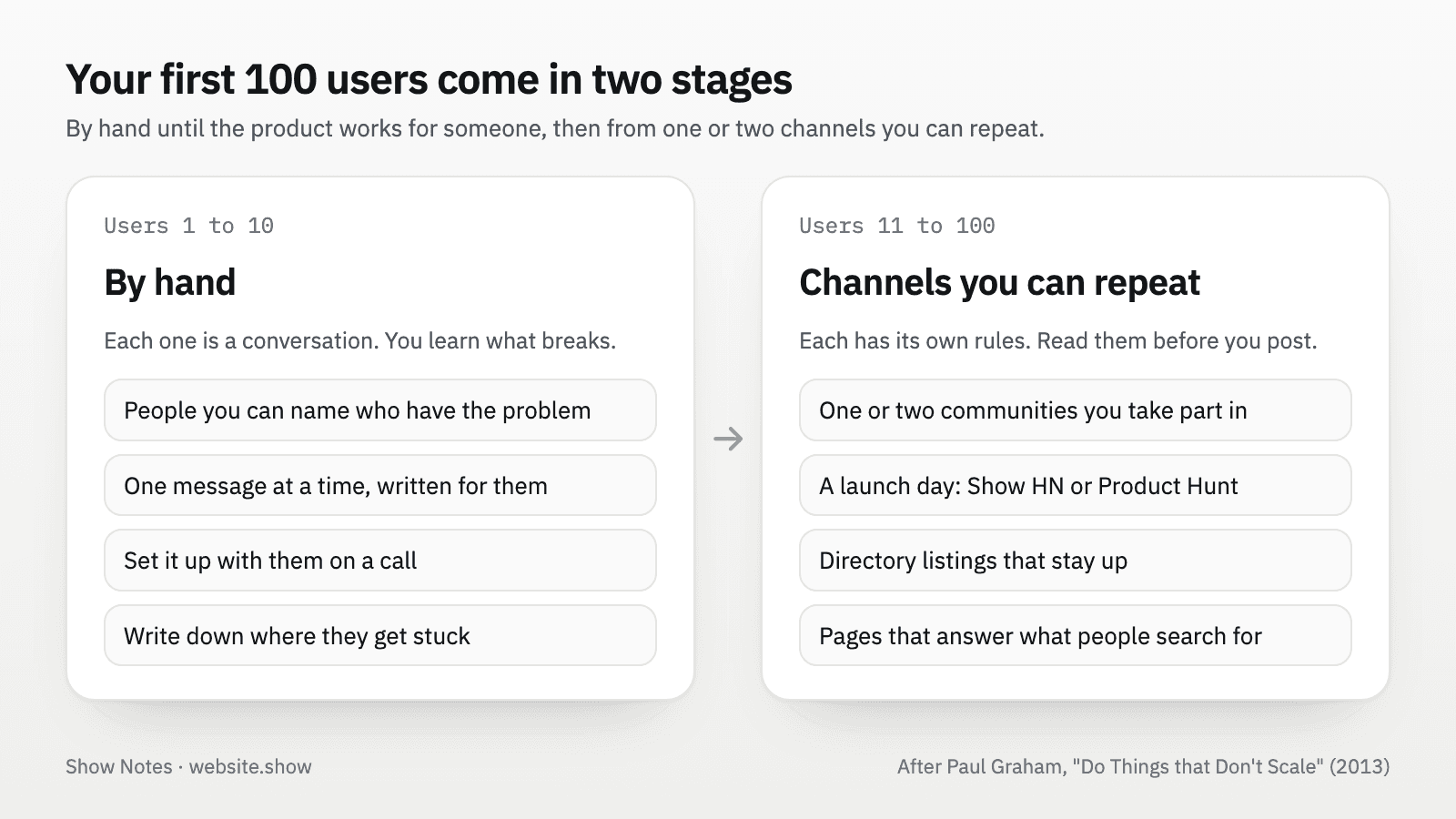
A new product has no search traffic, no reviews and nobody who has heard of it, so its first users are people the maker went and asked. Paul Graham made the case in 2013 in Do Things that Don't Scale. Nearly every startup has to recruit its first users by hand, he wrote, because they won't come on their own.
That is the first stage, and it covers roughly the first ten users. The second stage is finding one or two channels that bring people without a message from you to each one. That can be a community, a launch day, or listings and pages that people find by themselves. This guide covers both, with the rules each channel sets, taken from its own pages on October 6, 2026.
Why won't anyone find a new product on their own?
Because nothing points to it yet: search engines have few pages to rank, AI assistants have nothing to quote and nobody has mentioned it to a friend. Every channel that brings strangers works better with some proof, even if the proof is a handful of people who use the product.
Graham's essay also argues that small numbers are fine at this stage. With 100 users, ten more next week is 10% weekly growth, and by the essay's arithmetic, keeping that up for a year gives you about 14,000. He calls the feedback from your earliest users the best you will ever get, because at this size you can watch each of them use the product.
Who should your first ten users be?
People you can name who have the problem today. Ten names you can write to about their own situation are a better start than a post that a thousand strangers scroll past.
- You and people like you, if you built the product for a problem of your own. Then you mostly need to find your peers, which Graham says is usually straightforward.
- People who described the problem in public: a forum thread, a review of a competing tool, an issue on GitHub, a post asking for a recommendation.
- People you have worked with, who know you and will tell you what they really think.
- Members of a community you already take part in, where your name means something.
- People who follow what you post, if you build in public. Check that they are the people the product is for: an audience of other makers helps a tool for makers far more than a tool for dentists.
When the first few are using it, look at which kind of user is keenest and go find more of them. Graham's example is Pinterest. Ben Silbermann saw that many of its earliest users were into design, so he went to a conference of design bloggers to find more, and it worked.
How do you turn a yes into a user?
Set the product up with them on the spot instead of sending a link. When someone agreed to try Stripe, its founders asked for the person's laptop and set it up right there. A more cautious founder would have promised to email a link. Y Combinator calls this the Collison installation, after the two brothers who founded Stripe.
For a product that runs in the browser, the closest thing is a 15-minute call with a shared screen. You see where people hesitate, which words they misread and what they expected to happen. Write each of those down, and fix whatever stopped them before you write to the next person.
Once they are set up, look after them in ways a big company can't. Wufoo sent every new user a handwritten thank-you note for as long as it could. In Graham's words, what has to be great at the start is "the experience of being your user". Close attention can make up for a product that is still buggy.
Can you email people you don't know?
In the US you can, as long as each message follows CAN-SPAM, the federal law on commercial email. The Federal Trade Commission says that despite its name the law covers more than bulk email, and it makes no exception for business-to-business messages. Each email that breaks it can cost up to $53,088.
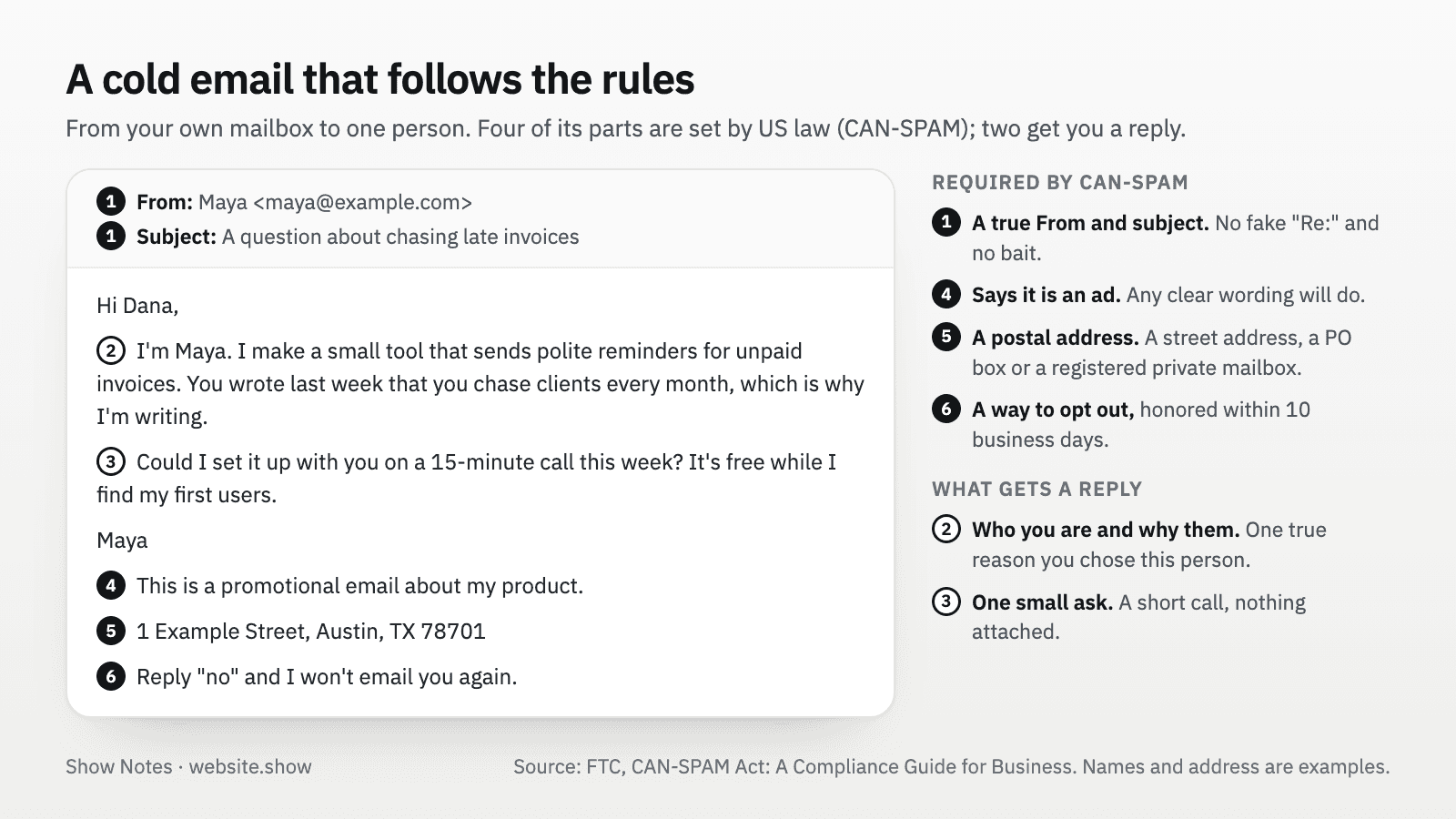
The FTC's compliance guide lists what each message needs. It must have a From line and headers that identify you, and a subject line that matches the content. It must say clearly that the message is an ad, and give your valid postal address and a clear way to opt out. You must honor an opt-out within 10 business days, and you can't sell or pass on the address of someone who has opted out.
Send these from your own mailbox, one at a time. The service that sends your product's receipts and password resets is the wrong tool for it. Resend, which sends ours, prohibits cold outreach, purchased lists and scraped contacts. It also says an account whose complaint rate goes above 0.08% may be shut down without warning. If that happens, your password resets stop too.
If the person lives outside the US, the rules where they live can apply too, and some countries require consent before any marketing email.
What can you post on Hacker News?
A Show HN, if people can try the product today. The Show HN rules describe it as things people can run on their computers or hold in their hands. They rule out blog posts, sign-up pages, newsletters and landing pages. If the product isn't ready to try yet, the rules ask you to come back when it is. Other things you made, such as a post about how you built it, go in as regular submissions.
The rest of the rules are about you. The project should be your own work and more than a quick one-off, and you should be around to answer questions in the thread. Make it easy to try, ideally without a sign-up or an email address, which the rules say gets you more feedback. Don't ask friends to upvote or comment, which the rules single out as not OK on HN.
Write the post and your replies yourself: the site's guidelines ask for no generated text in posts, and no generated or AI-edited text in comments. The same guidelines ask you not to use HN mainly for promotion, while posting your own work part of the time is fine. Every Show HN appears on the Show New page. One that clears a small points threshold moves to the Show page, so it can find readers without reaching the front page.
Where does Reddit draw the line on self-promotion?
Each subreddit draws its own, and Reddit's sitewide content policy tells you to follow it. Rule 2 asks you to abide by community rules, to take part authentically in communities where you have a personal interest, and not to spam. Some subreddits keep self-promotion to a weekly thread and some don't allow it at all, so read the rules on the community's page before you post.
Take part before you post: answer questions in the community for a while, so that your name means something when your product comes up. When you do mention it, say you made it. Posting as a happy customer of your own product from a second account is the kind of deception Rule 5 forbids. Reddit's enforcement runs from asking you to stop to suspending the account.
What does Product Hunt allow on launch day?
You can share your launch link anywhere you like. The one rule Product Hunt's launch page names is that you can't ask people directly to upvote, and it suggests asking them to visit and comment instead.
Launching is free, and you can hunt the product yourself, which Product Hunt encourages. Company accounts are prohibited, so post from your own. The page names 12:01 am Pacific Time as the best time to launch if you plan ahead, and the day you are most prepared for as the best day. You can launch again whenever you have a significant new version.
The first ten users are the people to tell. They have used the product and can say in the comments what it did for them, which is the kind of support the page asks for.
What keeps bringing users after the launch?
Pages that stay up and keep being found: listings on directories, your own pages that answer what people search for, and the AI answers that quote those pages. A launch gives you a day or two of attention. A listing or a useful page can keep sending visitors for as long as it is up.
Directories differ more than they look: some trade a followed link for a badge, some give it only to the day's winners, and some want a link back before they list you at all. Our comparison of seven of them shows what each free plan gets you. On website.show a listing is free, a person reviews it, and the link to your site carries utm_source=website.show, so the visits appear in your own analytics. The listing's manage page counts the visitors we sent as well.
For pages that answer searches, start from the words your first users chose on those calls. A question one of them asked is probably one that other people type into search. Then make sure AI crawlers can read those pages; our robots.txt guide shows how to check in two minutes.
How do you know which channel sent a user?
Tag every link you post with UTM parameters, and ask each new user where they heard of you. A link such as yoursite.com/?utm_source=reddit&utm_medium=social shows up under that source in most analytics tools, even when the browser sends no referrer.
Ask the question in the sign-up form or in your first email, and keep the answer next to the user. Self-reported answers are rough, yet they catch what analytics can't see, such as a mention on a podcast or a link shared in a group chat.
Then put your time where the users came from. Graham's advice is to start by hand and move to less manual methods gradually, and the count for each channel tells you which method to move to.
FAQ
What counts as a user?
Someone who used the product for the job it was made for, more than once. A sign-up is only a visit with an email address. Pick the action that shows the product worked for them, such as a second invoice sent or a second report run, and count the people who took it.
Is a waitlist worth building before launch?
It tells you who is curious and gives you people to write to, though a list is not users, and a sign-up page can't be a Show HN. Once there is something to try, write to the people on the list one at a time, as you would to anyone else.
Should your first users get the product for free?
It's your call, and either choice works if you're clear about it from the start. Free makes it easier to say yes; a price tells you sooner whether the product is worth money to them. One way to get both is to agree on the price at the start and make the first month free.
When do paid ads make sense for a new product?
Once you know who your users are and why they stay. Before that, an ad buys visits to a product nobody has shown to work, and the clicks teach you less than ten conversations would. When a channel is already bringing the right people, ads can bring more of them faster.