Most pricing advice for software is written for companies with a sales team. A one-person product has a simpler question: charge once, every month or once a year, and at what price does the payment itself start eating the revenue?
This guide works through that question with the published fees of three common payment providers, read on October 8, 2026. It is not tax or legal advice, and the numbers will move when providers change their prices, so redo the math with your own provider before you decide.
Should you charge once or every month?
Follow your costs: if each customer costs you money every month they use the product, charge every month. If they cost you almost nothing after the sale, a one-time price is honest and simple.
- Recurring costs per customer point to a subscription: servers that grow with usage, AI model calls, storage, email sending, third-party APIs billed per use. A one-time price here means your oldest customers slowly become your most expensive ones.
- A product that runs on the customer's machine, or a tool that is used once per project, points to a one-time price. A desktop app, a template, a plugin or a generator fits.
- Ongoing work you promise, like updates, new integrations or support, sits between the two. Many makers sell it as a one-time price with a year of updates included, and a renewal for the next year.
Revenue that repeats every month is easier to plan around. That is a reason to prefer a subscription when the product supports one, not a reason to force one on a product that does not.
How much do payment fees take?
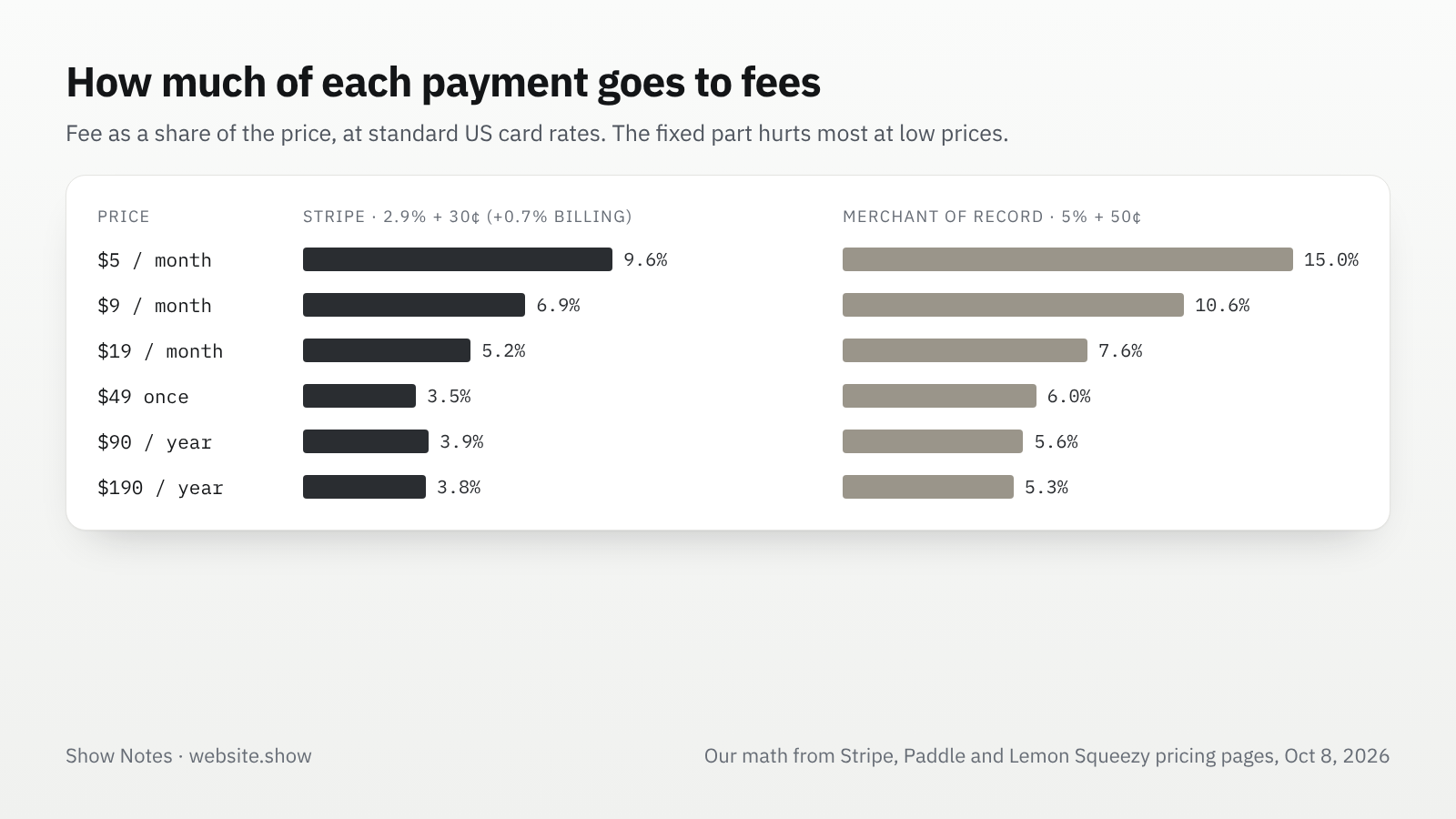
More than most makers expect at low prices, because every provider adds a fixed fee to each payment on top of the percentage. Stripe's standard rate for US cards is 2.9% plus 30 cents, and Stripe Billing adds 0.7% of subscription volume. Paddle and Lemon Squeezy, which act as the merchant of record and handle sales tax for you, each charge 5% plus 50 cents per transaction.
| Price | Stripe fee (2.9% + 30¢, plus 0.7% Billing) | Merchant of record fee (5% + 50¢) |
|---|---|---|
| $5 a month | $0.48, 9.6% | $0.75, 15.0% |
| $9 a month | $0.62, 6.9% | $0.95, 10.6% |
| $19 a month | $0.98, 5.2% | $1.45, 7.6% |
| $49 once | $1.72, 3.5% | $2.95, 6.0% |
| $90 a year | $3.54, 3.9% | $5.00, 5.6% |
| $190 a year | $7.14, 3.8% | $10.00, 5.3% |
The 0.7% Billing fee applies to the subscriptions only, not to the one-time $49. The two columns are not the same service. Stripe's fee covers the payment; sales tax and VAT are yours to handle, or you add Stripe Tax at its own price. A merchant of record sells the product to the customer on your behalf, so it collects and pays the tax and takes on chargebacks. International cards and currency conversion add more at Stripe, 1.5% and 1% on top of the rates above.
Is an annual plan worth offering?
Yes, for you and for the customer. One payment a year pays the fixed fee once instead of twelve times, so the fees fall even at the same yearly price.
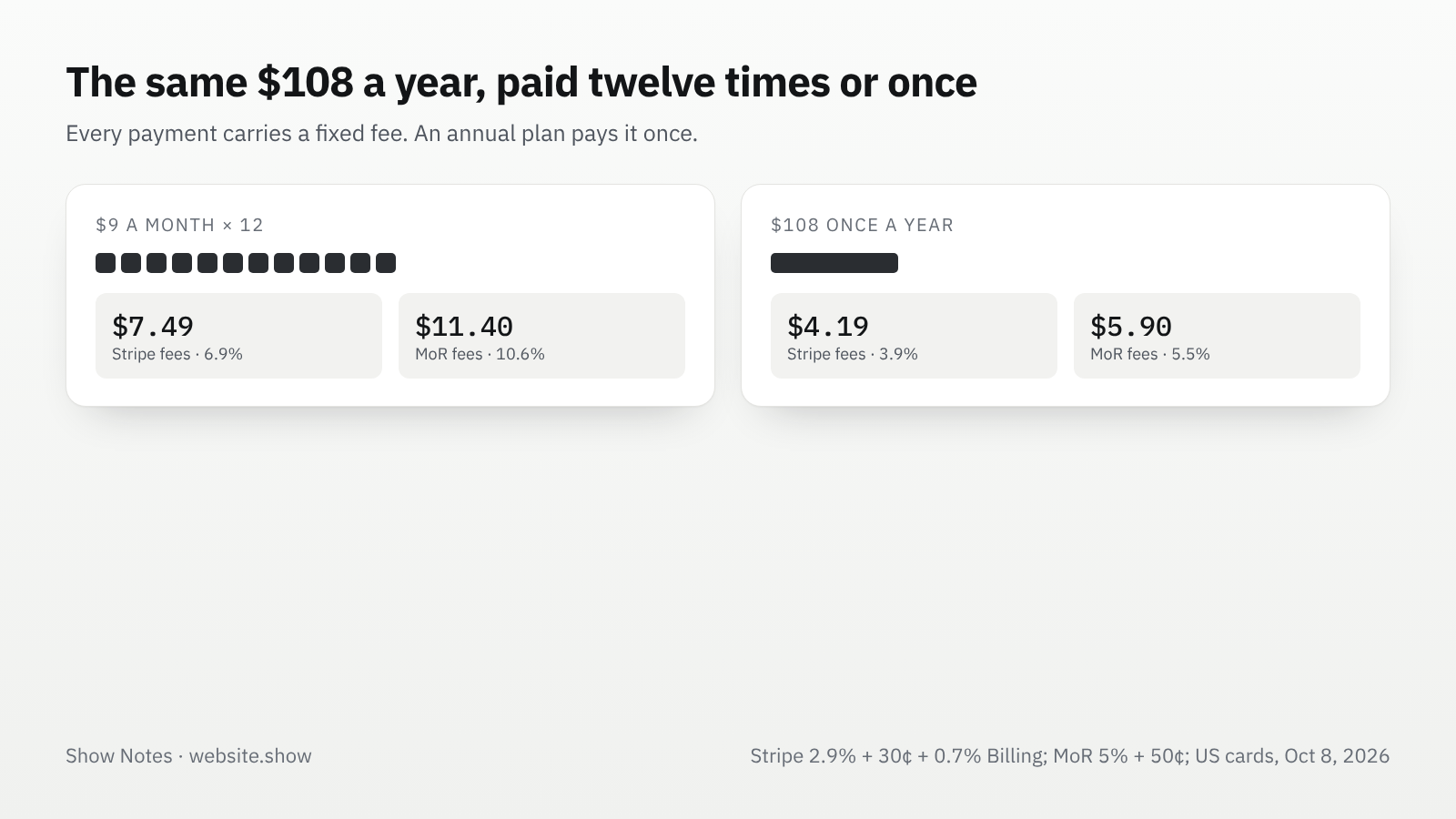
A $9 plan paid monthly for a year brings in $108 and costs $7.49 in Stripe fees, 6.9%. The same $108 paid once costs $4.19, 3.9%. At a merchant of record the difference is $11.40 against $5.90. Annual payers also cannot drift away month by month, and you get the year's money up front.
A simple way to set the annual price is two months free: charge ten times the monthly price for the year, about 17% off. It is easy to understand. On a $9 plan, $90 a year leaves you $86.46 after Stripe's fees, against $100.51 from twelve monthly payments: you trade about $14 for the money up front and a customer who stays the year.
How do you pick the actual number?
Start from what the product replaces, not from what it costs you to run. If it saves someone two hours a month, or replaces a tool they pay $30 for, that sets the range a buyer will accept. Your costs set the floor, and they should stay well below the price.
- Write down the alternative: the tool, the spreadsheet or the freelancer your buyer uses now, and what it costs them in money or time.
- Check your floor: monthly cost per customer plus the payment fee from the table above. If the price is not several times that, it is too low.
- Pick a round number and publish it. A visible price on your site answers the first question every buyer has, and assistants that summarize your product can quote it.
- Raise it for new customers when people stop hesitating. Keeping the old price for existing customers is the usual courtesy, and it costs little when the product is young.
Very low prices have a cost beyond the fees. A $3 plan needs many more customers to pay for the same month of your time, and every one of them can still email support.
What about lifetime deals?
A lifetime deal is a one-time price for a product that has ongoing costs. It brings cash and early users quickly, and it can work as a deliberate, limited launch offer. The risk is the one from the first section: every lifetime customer keeps costing money, and their number only grows.
If you run one, cap it by limiting the number of seats or the time it is on sale. Write down which future features are included, and work out what the product will cost to run for those customers in two years.
Where should your price appear?
On a page of its own at /pricing, in plain text, with what each plan includes. Visitors look for it before they sign up, and AI assistants answering "how much does X cost" can only quote a price they can read on your site.
Directories help here too. A listing that says whether there is a free plan or a trial answers the question people ask most before they click through. On website.show you can add those answers under your listing, and our comparison of launch directories shows what each one asks for. Once the price is public, our guide to your first 100 users covers finding the people to pay it.
FAQ
What is a good starting price for a micro SaaS?
There is no single number, but the fee table gives a lower bound. Below about $10 a month, fees take 7% to 15% of each payment, and support takes the same time as for a customer paying more. Start from what the product replaces, then check that the price clears your costs several times over.
Should I offer a free plan?
Offer one when free users cost you almost nothing and some of them will grow into paying ones. If each free user costs you server or model time, a free trial with an end date is usually safer than a free plan forever.
Do I need a merchant of record?
Not always: it handles sales tax and VAT in many countries for you, for a higher fee per payment. Selling through Stripe directly costs less per payment but leaves tax registration and filing with you. Check the rules where you and your customers are, or ask an accountant.
Sources
- Stripe pricing, standard US rates
- Paddle pricing
- Lemon Squeezy pricing
We read each pricing page on October 8, 2026, and calculated every fee in this post from those published rates. Fees differ by country and by card, and providers change them, so check the page before you set your price.