Most SaaS homepages either have no structured data or have a block copied from a generator, complete with a 4.9 star rating nobody gave. The first wastes an easy chance to state what the product is. The second breaks Google's rules for review markup and invites a manual action.
This guide shows a SoftwareApplication block you can adapt, what each property does, and where the line on ratings sits, from Google's documentation updated September 8, 2026 and schema.org, both read on October 9, 2026.
What is SoftwareApplication schema?
It is the schema.org type for "a software application", a kind of CreativeWork. It has three subtypes: WebApplication for software that runs in a browser, MobileApplication for apps installed on a phone, and VideoGame.
The type defines properties for what software has and other works do not: applicationCategory, operatingSystem, screenshot, featureList, softwareVersion, downloadUrl and more. Price comes from offers, which it inherits from CreativeWork.
A SaaS product is a WebApplication. You can use either name in the markup, since a WebApplication is also a SoftwareApplication.
What does Google require for a software app rich result?
Three things, all marked required on its software app page:
| Property | What Google asks for |
|---|---|
name | "The name of the app." |
offers.price | The price. For a free app, Google says to set it to 0. |
aggregateRating or review | The average rating, or a single review. One of the two is required. |
Two more are recommended: applicationCategory, which "must be a supported app type", and operatingSystem. Google accepts SoftwareApplication and its subtypes, with one exception: a page typed only as VideoGame gets no rich result and has to be co-typed with another type.
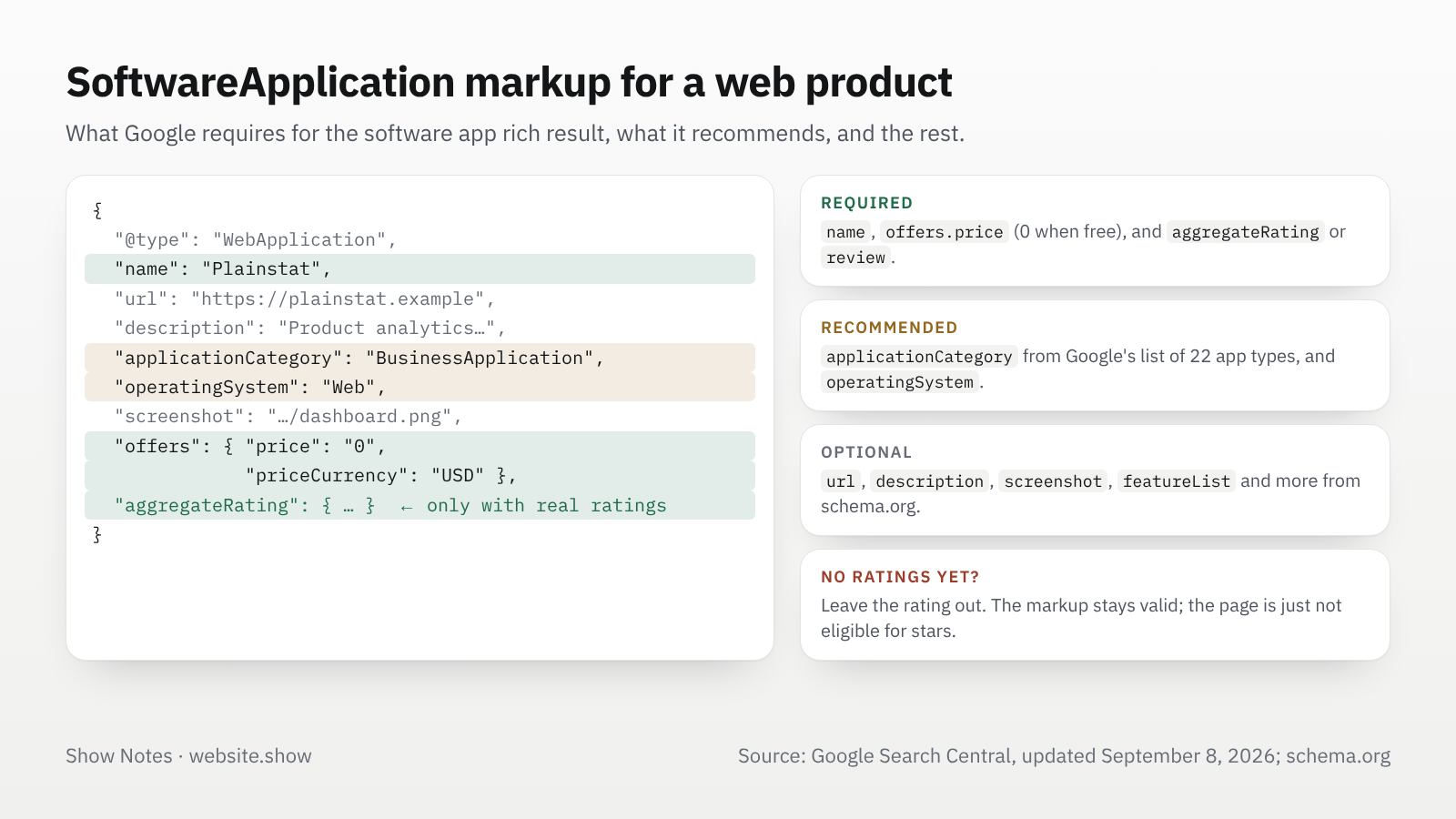
The rating requirement is the catch. Without aggregateRating or review, the markup is still valid schema.org, but the page is not eligible for Google's software app rich result.
Can a SaaS homepage show review stars in Google?
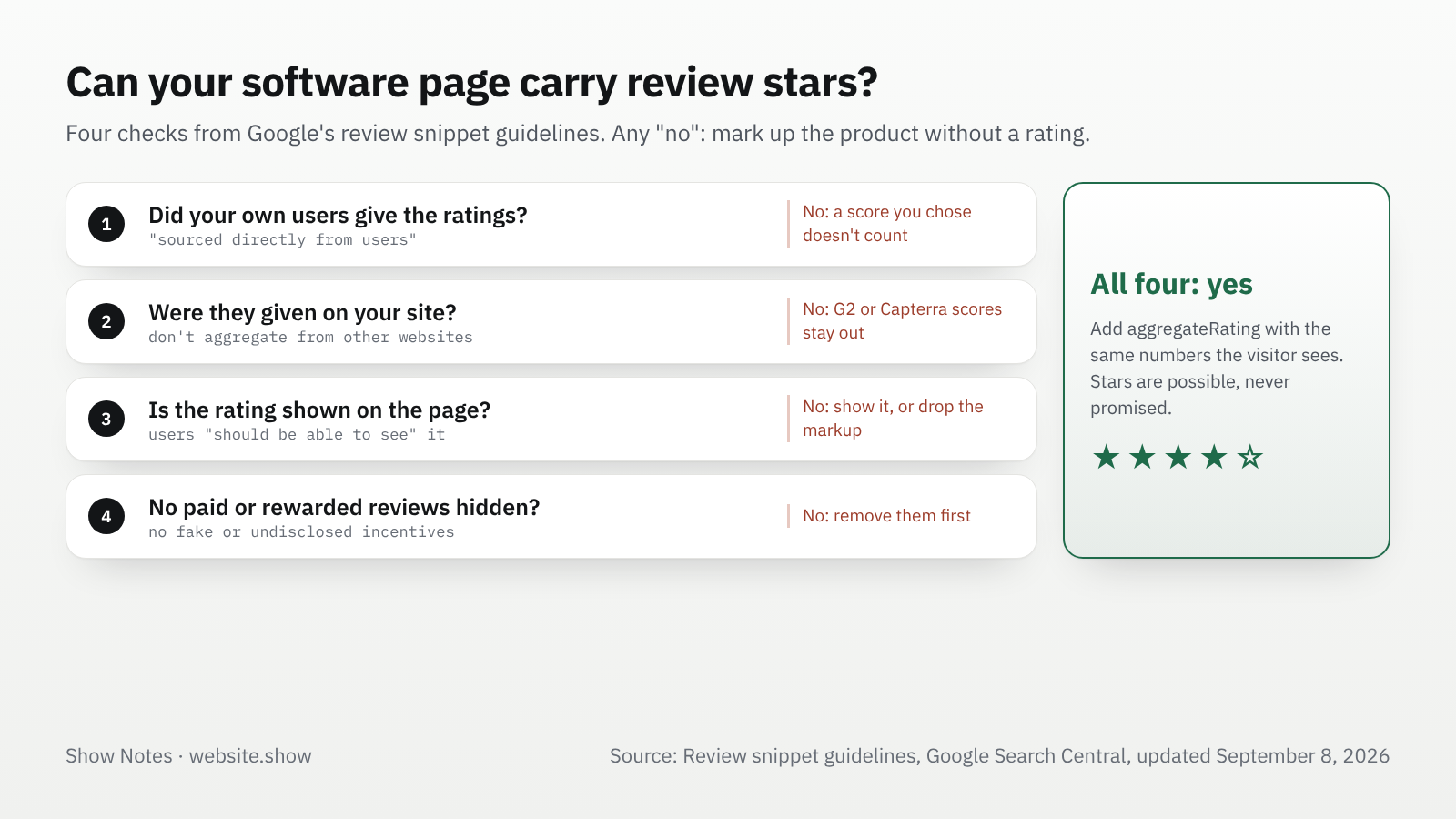
Only with real ratings from your own users, shown on the page. Google's review snippet guidelines, which the software app page points to, set the rules:
- "Ratings must be sourced directly from users." A score your team picked, or one an editor compiled, does not qualify.
- "Don't aggregate reviews or ratings from other websites." Your G2, Capterra or Product Hunt rating cannot go into your own markup.
- "If you use AggregateRating, users should be able to see that aggregate rating on the page." Markup for a number the visitor never sees breaks the rules.
- "Don't include fake or undisclosed incentivized reviews". Reviews you paid or rewarded people for, without saying so, are out.
Google also says it may take manual action against a site that breaks these guidelines. For most small products the answer is simple: there is no rating to mark up yet, so leave the property out and accept that there are no stars.
What does a SoftwareApplication example look like for a SaaS?
Here is a block for a made-up web product with a free plan and no ratings yet. Put it in a <script type="application/ld+json"> tag on the homepage.
{
  "@context": "https://schema.org",
  "@type": "WebApplication",
  "name": "Plainstat",
  "url": "https://plainstat.example",
  "description": "Product analytics for small SaaS teams, on one screen, without cookies.",
  "applicationCategory": "BusinessApplication",
  "operatingSystem": "Web",
  "screenshot": "https://plainstat.example/images/dashboard.png",
  "offers": {
    "@type": "Offer",
    "price": "0",
    "priceCurrency": "USD"
  },
  "publisher": {
    "@type": "Organization",
    "name": "Plainstat",
    "url": "https://plainstat.example"
  }
}
Every value has to match what the page says. If the homepage shows a $9 plan and no free one, the price is 9. If the product works only in Chrome, say so in operatingSystem rather than "Web". When users do start rating the product on your site, add aggregateRating with ratingValue and ratingCount, and show the same numbers on the page.
The publisher node names who makes the product. Our site check, which runs on any homepage and on every product listed on website.show, looks for exactly this pair on a homepage: an Organization and a Product or SoftwareApplication. A homepage with only one of them gets half the points for structured data.
Which applicationCategory should you use?
One of the values Google lists as supported; for most SaaS products that means BusinessApplication, DeveloperApplication, DesignApplication, FinanceApplication, CommunicationApplication or UtilitiesApplication. The full list on Google's page has 22 values, from GameApplication to ReferenceApplication.
Schema.org itself accepts any text or URL here. Google is stricter, so a free-form value like "Analytics" passes a schema validator and still misses Google's recommendation. Pick the closest supported value and describe the niche in description instead.
Is it worth adding without ratings?
Yes, though not for the stars, which need ratings. Structured data states the product's name, type, price and maker as data, so a parser does not have to guess them from your page copy. It takes half an hour, and it does not drift if you generate it from the same source as the page.
Expect less than the generators promise: Google documents what the markup makes eligible, not a ranking boost, and we have found no AI assistant that documents reading it when choosing what to recommend. On website.show each listing page carries a SoftwareApplication node with the product's name, tagline, category and, when there is one, a screenshot. It has no rating, because there are no ratings on the site to mark up. Browse the catalog and view a listing's source to see one.
How do you test SoftwareApplication markup?
With Google's two free tools and one look at the page.
- Rich Results Test: paste the URL to see whether Google reads the markup and whether the page is eligible for the software app rich result. It names the missing required property.
- Schema Markup Validator at validator.schema.org: checks the markup against schema.org itself, for every type, rich result or not.
- The page in a browser: every price and rating in the markup should be visible to a visitor.
After the site is live, Search Console's reports for rich results show errors across all your pages, not just the one you tested.
FAQ
Should a SaaS use Product or SoftwareApplication schema?
SoftwareApplication, or its WebApplication subtype, because it has the properties software needs, such as operating system and app category, and it is the type Google's software app documentation covers.
Can I mark up my G2 or Capterra rating?
No: Google's review snippet guidelines say not to aggregate reviews or ratings from other websites. You can quote and link a third-party review on your page as text, without putting its score in your markup.
Do I need operatingSystem for a web app?
Google lists it as recommended, not required. For a browser-based product, "Web" or the browsers it supports describe it honestly, and leaving it out does not make the markup invalid.
Sources
- Software app (SoftwareApplication) structured data, Google Search Central, updated September 8, 2026
- Review snippet structured data, Google Search Central, updated September 8, 2026
- SoftwareApplication, schema.org
- Rich Results Test, Google
We read every page above on October 9, 2026. Google changes which rich results it shows from time to time, so run the Rich Results Test before you rely on one.