Founders now ask two questions at launch: does Google show my product, and does ChatGPT? The second one attracts a lot of confident advice with little behind it. OpenAI has published a short list of what it needs from a site, and it is shorter than most guides suggest.
This guide sticks to OpenAI's own help pages and crawler documentation, read on October 8, 2026, and marks clearly where they stop and our reasoning begins.
Can any website appear in ChatGPT search?
Yes: OpenAI's publisher FAQ says "Any public website can appear in ChatGPT search." There is no form to fill in and no account to create. The site has to be public, and OpenAI's search crawler has to be allowed to read it.
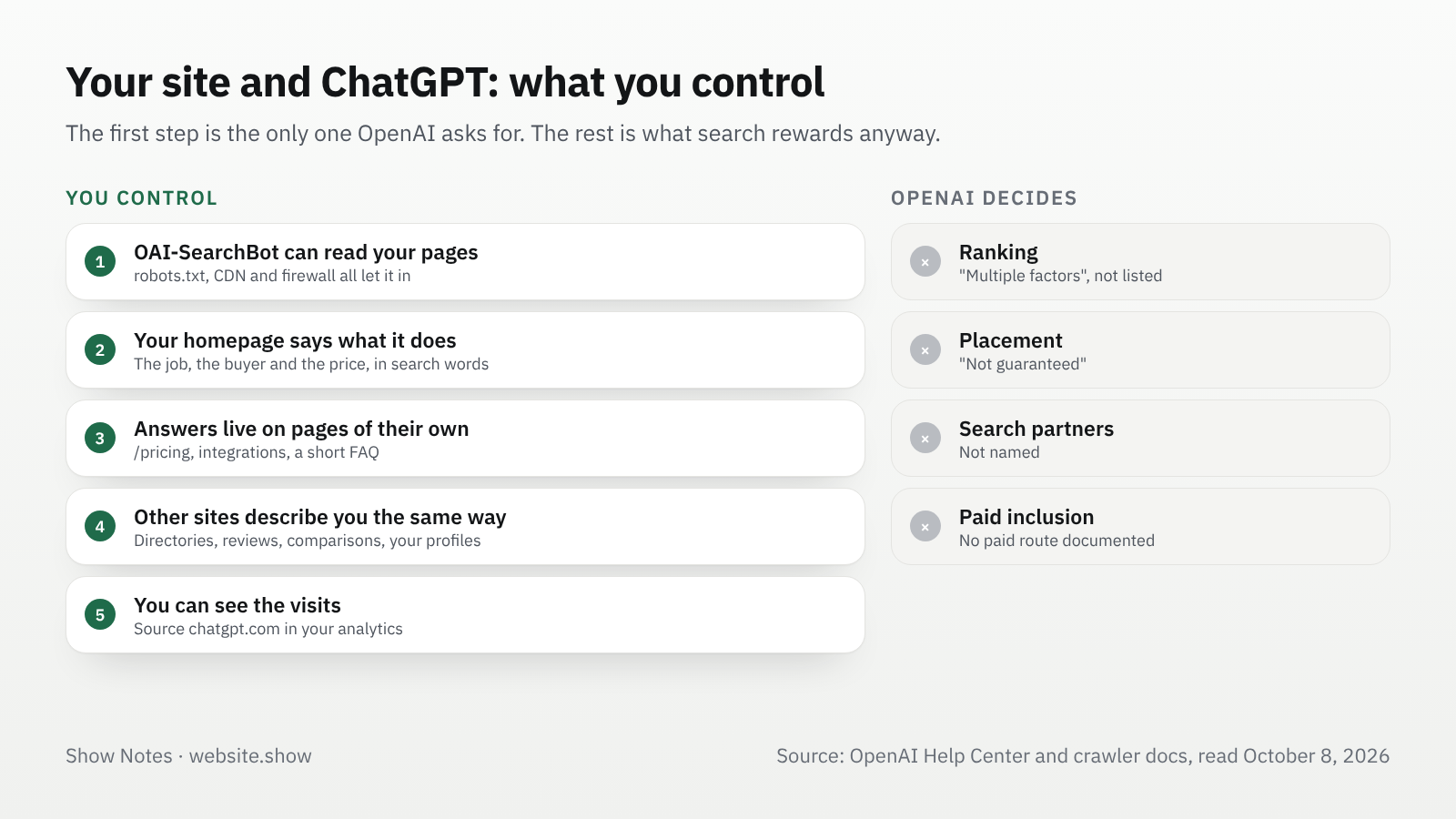
What OpenAI does not promise is a spot in any particular answer. Its help page on ChatGPT search says results are ranked "using multiple factors intended to help users find relevant, reliable information" and that "placement is not guaranteed". It does not list those factors.
How does ChatGPT search pick its sources?
OpenAI describes two ways in. Its own crawler, OAI-SearchBot, fetches pages so they can be shown in ChatGPT's search features. And ChatGPT search "sometimes partners with other search providers": it rewrites the question into one or more targeted queries and sends them to those providers. OpenAI does not name them on that page.
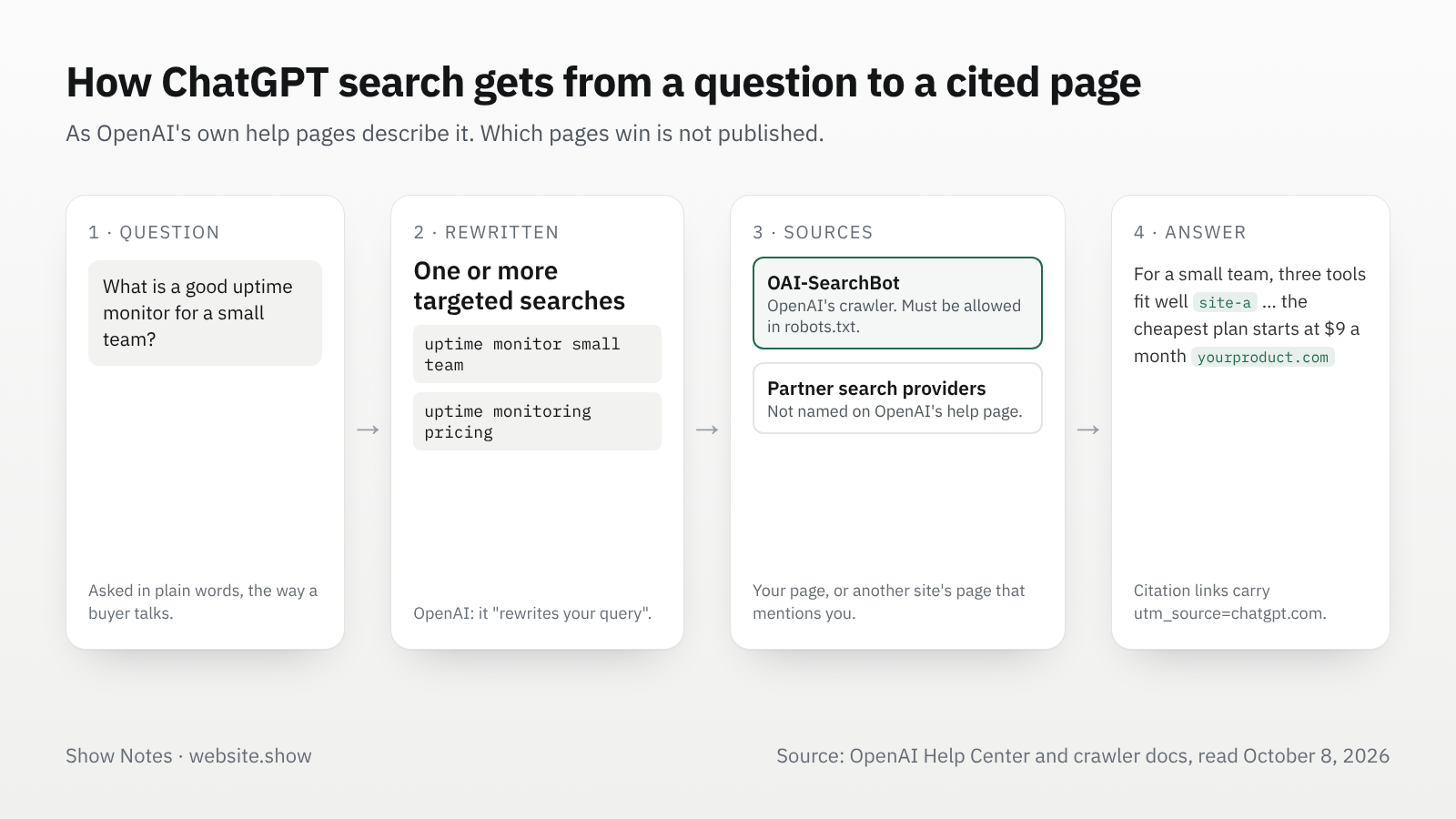
So a question like "what is a good uptime monitor for a small team" does not go to a list of approved brands. It becomes searches, and the answer is written from the pages those searches return. The page cited may be your homepage, or it may be someone else's comparison that mentions you.
How do you let ChatGPT find your site?
Allow OAI-SearchBot in your robots.txt, because OpenAI's crawler documentation says sites that opt out of it "will not be shown in ChatGPT search answers", though they may still appear as plain navigational links. It also says a robots.txt change can take "~24 hours" to reach its systems.
Three details catch site owners out:
- GPTBot is a different crawler: it collects training data. Blocking it keeps your pages out of training, and OpenAI treats it separately from search.
- A CDN or firewall can block the bot even when robots.txt allows it. OpenAI publishes the IP ranges OAI-SearchBot uses so you can allow them.
- A noindex tag only works on pages the bot may fetch: OpenAI notes that its crawler must be allowed to crawl a page to read the meta tag on it.
Our guide to robots.txt for AI crawlers shows how to read your file and which rules to keep for each bot, and our free AI crawler checker reads it for you.
How do you get your website recommended by ChatGPT?
OpenAI does not publish a method, so this part is our reasoning from how it says search works. If answers are written from pages that searches return, you want good pages to exist for the searches your buyers would run.
- Say plainly what the product does: your homepage should state the job, the buyer and the price in words a person would search for. A model cannot cite a feature it has to guess from a slogan.
- Put the answers on your own pages: pricing at
/pricing, integrations on a page of their own, a short FAQ. An assistant asked "does X have a free plan" can only quote a page that says so. - Be described on other sites: questions like "best tool for X" lead to lists, reviews and directories, so a product nobody else has written about has fewer pages that can surface it.
- Use the same name and description everywhere: when your site, your profiles and your listings agree, every page a search returns tells the same story.
None of this is specific to ChatGPT, which is the point. The pages that help a person decide are the pages any search system has a reason to show. Our guide to your first 100 users covers where those other mentions come from at launch.
How do you see traffic from ChatGPT?
Look for the tag OpenAI adds to every link it sends: its publisher FAQ says "ChatGPT automatically includes the UTM parameter utm_source=chatgpt.com in referral URLs", so visits from a cited link show up with chatgpt.com as the source in Google Analytics, Plausible and most other tools.
The count is a floor, not the full picture. Someone who reads your name in an answer and types your address later arrives as a direct visit, and nothing in your analytics links it back to the chat. A short "How did you hear about us?" field on sign-up catches some of those.
Directories that tag their links help in the same way. Every listing on website.show links to the product with utm_source=website.show, and listing a product shows its maker how many visitors we sent.
What doesn't get you into ChatGPT?
Anything OpenAI never asks for, as far as its own pages go. Its publisher FAQ and crawler page say nothing about paying for placement, structured data, sitemaps or llms.txt. That does not mean those things are useless for other reasons, but none of them is a documented way into ChatGPT's answers.
The one other request OpenAI makes concerns its Atlas browser agent, not search: it reads ARIA roles and labels to understand buttons, menus and forms, so following WAI-ARIA practice helps the agent use your site. That matters for a product people might sign up to through an agent, and it is good accessibility anyway.
Be wary of anyone who sells guaranteed ChatGPT placement. OpenAI says placement is not guaranteed, so nobody outside OpenAI can guarantee it either.
Is ChatGPT different from Google's AI Overviews?
The idea is the same, the crawler is not. Google says there are no additional requirements to appear in AI Overviews or AI Mode: a page that Googlebot can crawl and index, and that is eligible for a snippet, can be used. ChatGPT needs OAI-SearchBot allowed instead.
So check both bots in your robots.txt and your firewall. After that, the work for both is the same clear pages, and the same mentions on other sites.
FAQ
How long does it take to show up in ChatGPT?
OpenAI gives a time only for robots.txt changes, about 24 hours. Being cited depends on whether searches for your topic return your pages, which for a new site takes as long as being found in search generally.
Does ChatGPT use Google or Bing results?
OpenAI says ChatGPT search sometimes partners with other search providers and sends them rewritten queries, without naming the providers on its help page. Being indexed by the major search engines widens the pool any assistant can draw from.
Can I pay to appear in ChatGPT answers?
OpenAI's publisher documentation describes no paid route into search answers. The only step it lists is allowing OAI-SearchBot.
How do I keep a page out of ChatGPT search?
Add a noindex meta tag and leave the page open to OAI-SearchBot, so the crawler can read the tag. Blocking the bot for the whole site keeps pages out of answers, but they may still appear as plain navigational links.
Sources
- Overview of OpenAI crawlers, OpenAI
- Publishers and developers FAQ, OpenAI Help Center
- ChatGPT search, OpenAI Help Center
- AI features and your website, Google Search Central, updated December 10, 2025
- WebsiteShowBot: what our crawler fetches
We read each page above on October 8, 2026. OpenAI's help pages show no exact update date, and they change often, so check them before you rely on a detail.